 Chapter 02 / 6
One Product, Many Markets: How to Find the Desire That Actually Scales
A brand has been running Facebook ads for a year. They found a desire that worked. Revenue climbed. Then it stopped climbing. They make new creatives. Same desire, different format
A brand has been running Facebook ads for a year. They found a desire that worked. Revenue climbed. Then it stopped climbing. They make new creatives. Same desire, different format. Nothing moves. They test new audiences. Same desire, different targeting. Nothing moves. They restructure the campaign. Same desire. Nothing moves.
Six months pass at the same revenue number.
The typical response is to try harder on the creative side. A better video. A stronger hook. A new UGC angle. But the real problem isn't the creative. It's that they've maxed out the market for the desire they're speaking to — and they don't realize it, because they're thinking about their product as if it only has one market.
It doesn't. Every product can speak to multiple completely different desires, and those desires have completely different market sizes. The one you're speaking to right now might be a small pond. There's probably a much bigger one nearby that you haven't tried yet.
The paint by numbers proof
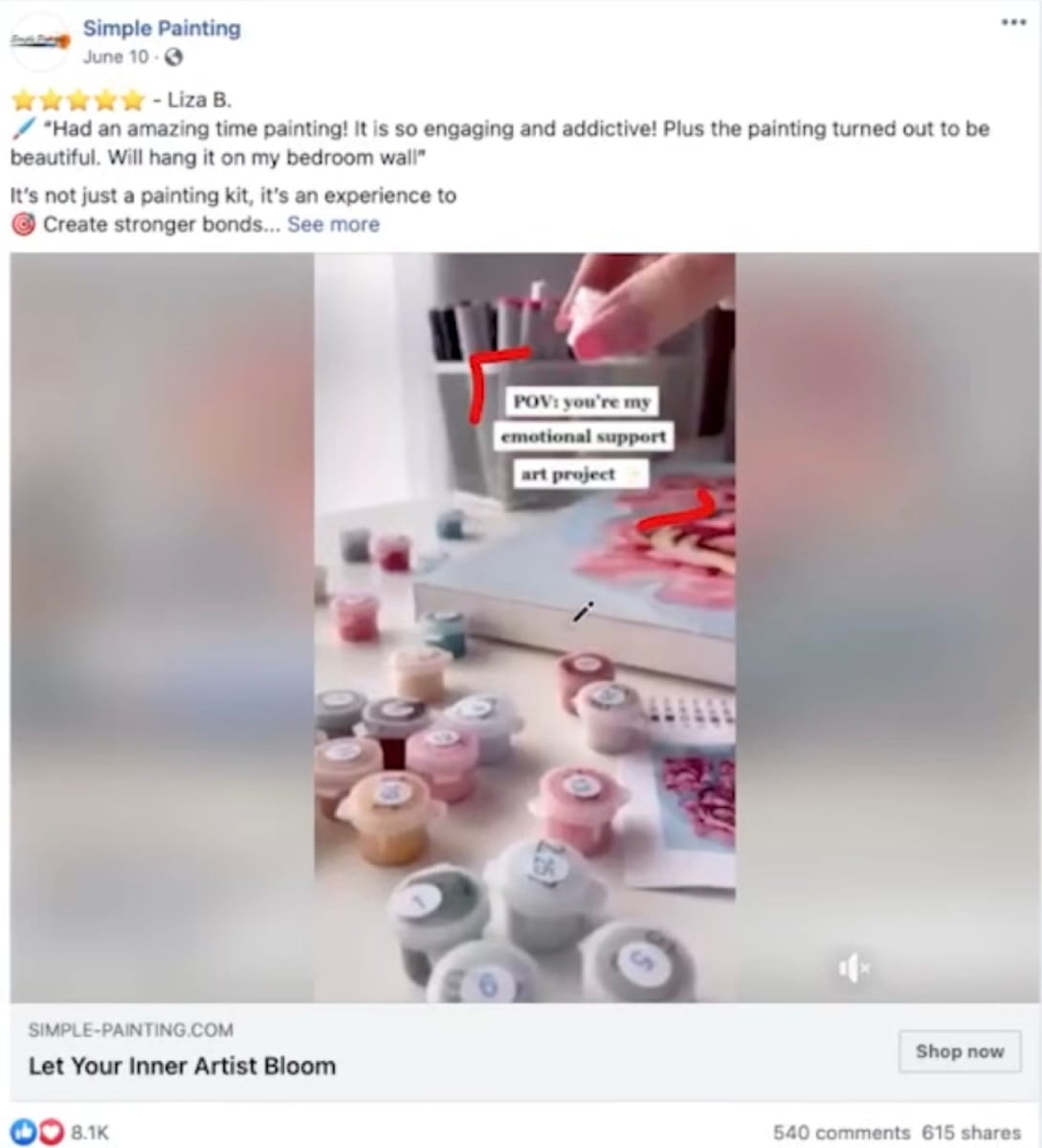
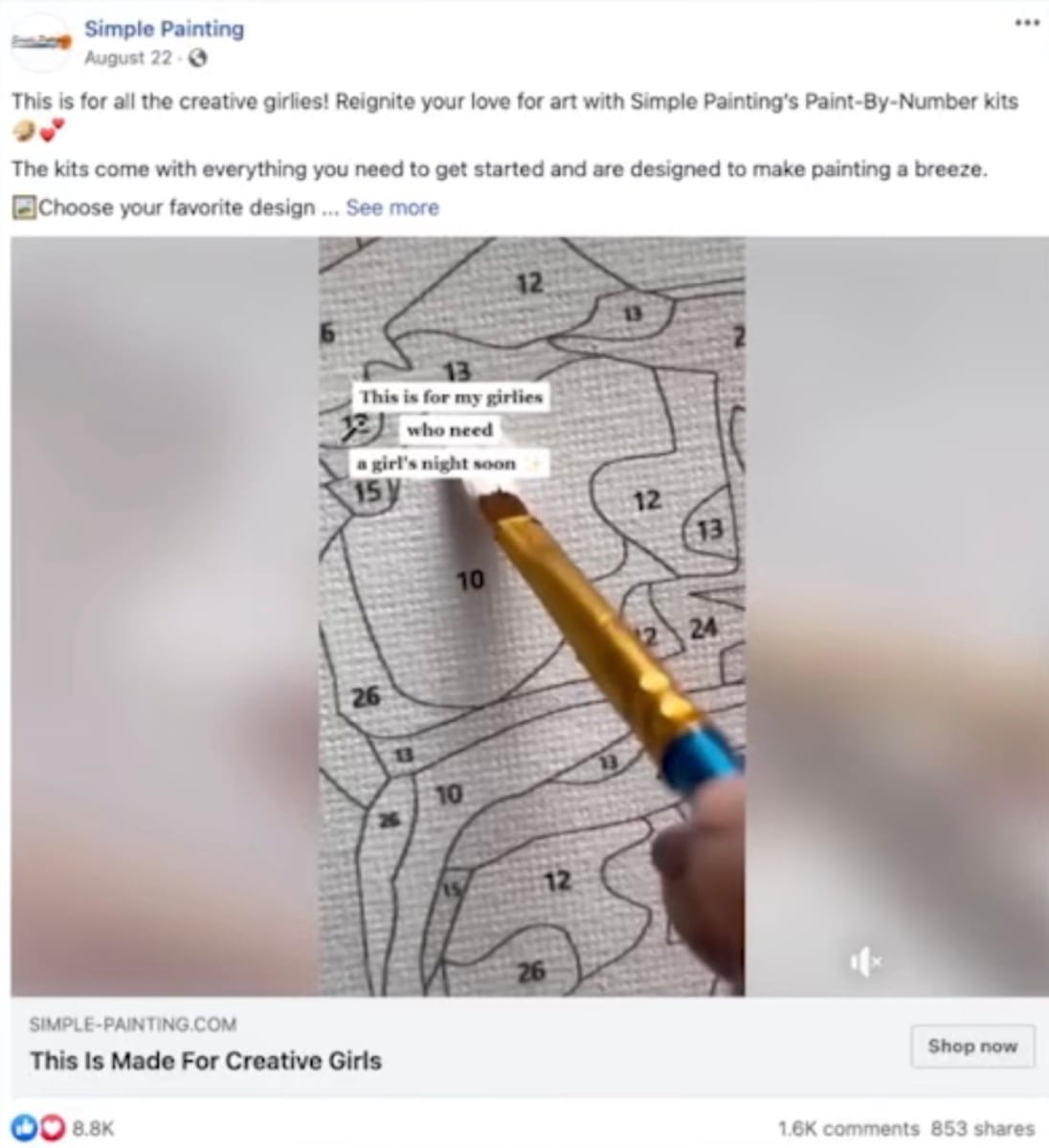
The same brand that went from $130,000 to $1.1 million a month demonstrates this so cleanly it's worth going through in detail.
They had been positioning their product around emotional support — stress, anxiety, mental health. The hook: "POV you're my emotional support art project." This wasn't a fabricated positioning. Lots of people actually buy paint by numbers for exactly this reason — it's calming, it gives you something to do with your hands when you're anxious, it helps you decompress.
But "people who are actively seeking stress relief through art" is a defined, bounded market. It's a real market. It's just not a massive one. And once you've saturated it, you're stuck.
The pivot wasn't complicated. Instead of emotional support, they went after social activity. The hook: "This is for my girlies who need a girls' night soon."
That desire — wanting to do something fun with friends, specifically girls wanting a group activity, specifically girls' night — is a vastly larger market. Practically every woman has a friend group that does girls' nights. The desire is broad, relatable, and frequent. It doesn't require someone to be in a specific emotional state. It just requires them to have friends and like doing fun things, which is most people.
The product didn't change. The platform didn't change. The budget didn't change. The desire changed. And revenue went from $130,000 a month to $1.1 million a month.
The lesson: smaller market equals less money. Bigger market equals more money. And until you've found the biggest desire your product can credibly speak to, you haven't found your ceiling.
Why brands get stuck at one desire

There are a few reasons brands fixate on a single desire and stay there even when the numbers stop growing.
They found something that worked and they don't want to mess with it. This makes sense as a short-term instinct. But once a desire is saturated, loyalty to it becomes a ceiling. The brand is now competing with itself for the same pool of buyers.
They haven't thought explicitly about what other desires exist. Most brands build their positioning around the desire that's most obvious from the product's features — which is usually the narrowest one. The pain by numbers brand's most obvious positioning was therapeutic. The bigger market was social. Obvious positioning is rarely the biggest market.
They think of their product as having one category, which maps to one desire. Paint by numbers is in the "crafts" category. Crafts maps to "creative outlet." But the same product is also in the "social activities" category, the "date night" category, the "gifts" category, the "stress relief" category, and the "things to do with your hands while watching TV" category. Each of those is a different desire, a different market, a different size.
How to map the desires your product can reach

Start with the Feature → Performance → Benefit → Desire chain from Article 1. But don't stop at one desire at the end. Instead, map every realistic desire your product could connect to.
For a paint by numbers product, that list might include:
- Stress relief and anxiety management (the one they started with)
- Girls' night activity (the one that unlocked 8x growth)
- Date night activity for couples
- Gift idea for a friend or parent
- Creative hobby for beginners with no artistic talent
- Something relaxing to do while watching TV
- Activity for family nights or birthday parties
- Travel activity for people on trips who want to disconnect
- Retirement hobby for older adults looking for stimulating activities
That's nine different desires. Each one has a different market size. Each one targets a slightly different person or context. Each one would require a different hook, a different scenario in the creative, and a different angle in the copy.
Some of those desires are enormous. "Gift idea" alone is a massive market — there are millions of people at any given time trying to figure out what to give someone. "Girls' night" is enormous. "Stress relief" is real but smaller than it appears, because the people who are actively searching for stress relief through art as opposed to exercise, meditation, sleep, or therapy are a subset of a subset.
How to compare the sizes
Before you go build ads for every desire on your list, you want to prioritize. The fastest way to estimate the relative size of two desires is YouTube and TikTok search volume — not for your product, but for the desire itself.
Search the desire on TikTok. If there are a handful of videos with 1,000 views each, that's a small market. If you search "girls' night" and there are videos with tens of millions of views, that's a massive market. The views tell you how many people care enough about this topic to watch content about it — a reasonable proxy for how many people have the desire.
Do the same on YouTube. Cross-reference the two. You'll quickly see which desires have enormous organic interest and which are niche.
This isn't a perfect research method, but it's fast and it gives you a relative ranking before you spend money testing.
How desire size connects to revenue ceiling
Here's the math in plain terms.
The revenue you can generate from a desire is bounded by the size of the market for that desire. If 100,000 people in the US are actively seeking "emotional support through art crafts" at any given time, and you capture even 5% of them, that's 5,000 buyers. If your AOV (average order value) is $60, that's $300,000 in revenue — across your entire lifetime with that desire, not per month.
Contrast that with a desire held by tens of millions of people — "I need a fun girls' night activity." Even at 0.1% capture, you're looking at tens of thousands of buyers with room to keep growing. The math is completely different.
This is why two brands with the same product can be at completely different revenue levels — and why the higher-revenue brand isn't necessarily doing "better marketing." They may have just found a bigger desire.
When to go looking for a new desire

The trigger is time, not tactics. Specifically:
If you've been stuck at the same revenue level for six months or more, and you've genuinely tested multiple different creative approaches for the same desire — new hooks, new formats, new angles, new spokespeople — and nothing has moved the needle, you've most likely saturated the desire.
At that point, the move is not another creative test. It's to pause and ask: What's a completely different desire this product could speak to? One we haven't tried yet?
Go back to your desire list. Pick the next biggest one. Build three to five creatives specifically for that desire. Test them. You're not iterating on what you have — you're opening a new market.
This single shift — from "let's make better creatives" to "let's find a different desire" — is the most overlooked scaling lever in performance marketing. It unlocks revenue ceilings that months of creative iteration will never touch.
The checklist
- List every desire your product can credibly speak to — aim for at least 5, ideally 8-10
- Do not stop at the most obvious desire — that's usually the smallest one, and it's where everyone already is
- Estimate the relative size of each desire using TikTok and YouTube view counts before spending money
- Rank your desires by estimated market size — largest first
- Start testing the largest untested desire when you've been stuck at the same revenue for 6+ months
- Never confuse "better creatives for the same desire" with "a new desire" — they're completely different moves with different ceilings
- If you've been stuck for 6 months and only tried new creatives, you need a desire audit, not a creative sprint
Next: [The 4 Levels of Desire Intensity — Why Some Buyers Act Immediately and Others Never Do →](03-desire-intensity-levels.md)