Scale with Desire: The Complete Facebook Ads Psychology Playbook
The desire-based framework that took a brand from $130K to $1.1M/month in Facebook ad revenue — desire identification, intensity levels, seasonal timing, research methods, and AI-powered ad writing.

A paint by numbers brand was stuck at $130,000 a month. The ads were running. The creatives were decent. The product was good. But the numbers refused to move.
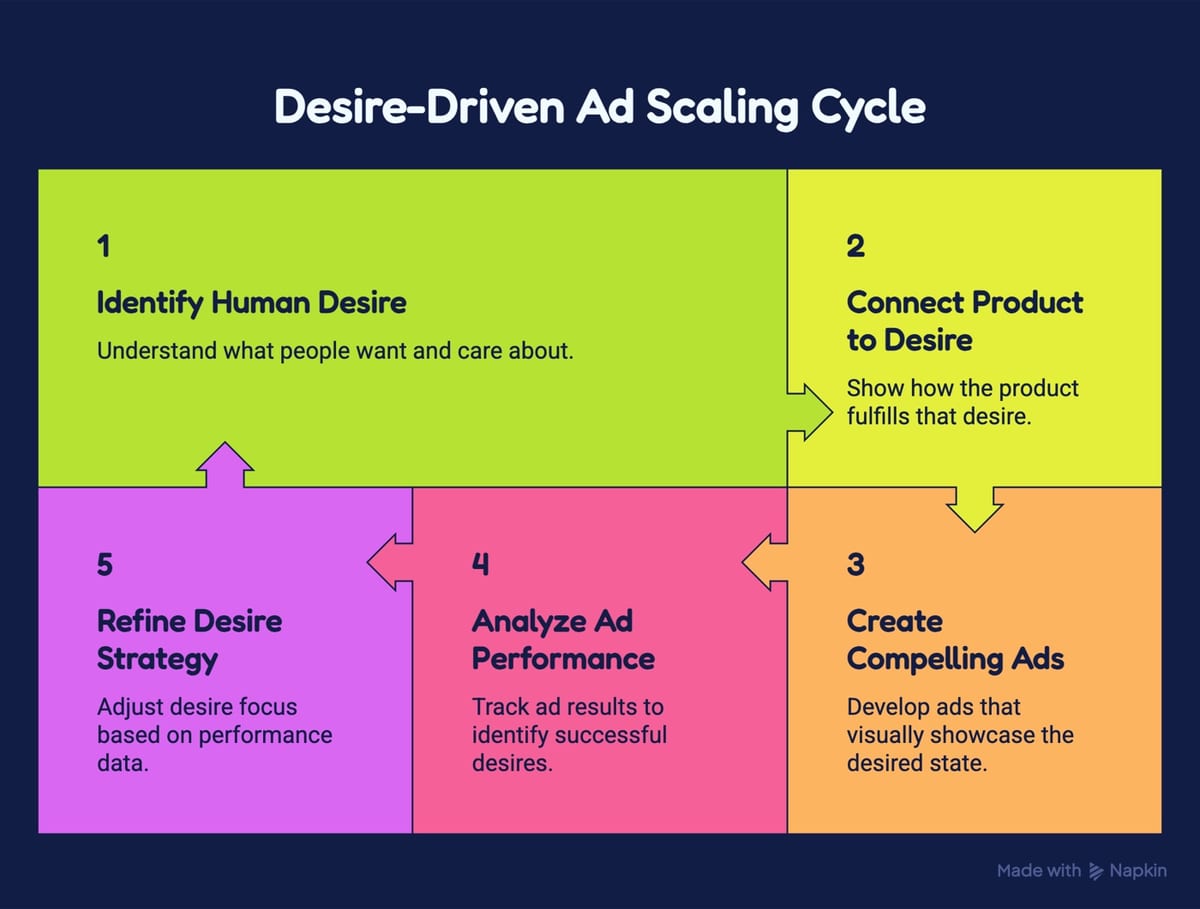
The diagnosis wasn't the creative format, the campaign structure, or the budget. It was the desire.
They had been positioning the product around emotional support — stress, anxiety, therapeutic benefits. The hook was something like: "POV you're my emotional support art project." The desire was real, but the market for it was small. They changed one thing: the desire they were speaking to. New hook: "This is for my girlies who need a girls' night soon."
Same product. Same platform. Same ad account. Different desire.
Revenue went from $130,000 a month to $1.1 million a month. Profit went from $19,000 a month to $198,000 a month.
The operating system behind this entire playbook: Your product doesn't have one market. It has many markets, each defined by a different desire, each of different sizes, each with different urgency levels that shift throughout the year. The job of Facebook advertising isn't to show people your product — it's to show people what they want, and then position your product as the thing that gets it for them.
What's in this playbook
- # — Article — What you'll walk away with
- 1 — Desire and the Bridge Framework — The foundational mental model — current state, desired state, and how your ad is the bridge between them
- 2 — One Product, Many Markets — How to identify which desires are massive vs. tiny, and why finding the right one unlocks a new ceiling
- 3 — The 4 Levels of Desire Intensity — Must Be Nice vs. Bleeding Neck — the intensity framework that determines price sensitivity and scalability
- 4 — Seasonal Relevance and Timing — Why desire intensity isn't static, how to use Google Trends to time your scaling, and the BFCM playbook
- 5 — The 6 Research Methods — The complete process for finding and validating desires — surveys, Reddit, TikTok, competitor reviews, and TrendTrack
- 6 — Writing Desire-Led Ads with AI — The full AI workflow for scaling copy across multiple desires, plus the 6 mistakes that kill scaling
Who this is for
- Ecommerce brand owners running Facebook ads and stuck at a revenue plateau
- Media buyers and performance marketers who want to go beyond creative iteration and attack the problem at the positioning level
- Agencies looking for a systematic framework to unlock new revenue for clients
You need basic familiarity with Facebook Ads Manager — knowing what a campaign, ad set, and creative are. You don't need any prior knowledge of positioning frameworks or consumer psychology.
Where to start
If you're brand new to this approach: start with Article 1 to understand the foundational model.
If you've been stuck at the same revenue for 3+ months: jump to Article 2 first, then come back to Article 1.
If you have a product and you're about to create your first set of ads: read Articles 1, 3, and 5 in order — those three give you everything you need to start.
Inside this playbook
6 chapters · read in any order

Desire and the Bridge Framework: The Foundation of Every Scalable Facebook Ad
A paint by numbers brand was generating $130,000 a month. Decent money. But the business had been stuck there for months, and nothing seemed to move the needle — not new creatives,
⏱ 7 min Read →
One Product, Many Markets: How to Find the Desire That Actually Scales
A brand has been running Facebook ads for a year. They found a desire that worked. Revenue climbed. Then it stopped climbing. They make new creatives. Same desire, different format
⏱ 7 min Read →
The 4 Levels of Desire Intensity: Why Buyers Act Immediately or Never
Ad performance is crushing it. Then one week it isn't.
⏱ 9 min Read →
Seasonal Relevance: When to Push Hard and When to Hold Back
A brand sells a dry skin product. The product is genuinely good. The ads are solid. The desire — relief from dry, cracked, uncomfortable skin — is real and specific.
⏱ 8 min Read →
The 6 Research Methods: How to Find and Validate the Right Desire
A brand had 6,000 customers. They sent them a survey. 652 people responded.
⏱ 11 min Read →
Writing Desire-Led Ads with AI: The Complete Workflow and the 6 Mistakes That Kill Scaling
The research is done. The desire is identified. The market size is validated. The intensity is right. The seasonal timing is good.
⏱ 13 min Read →