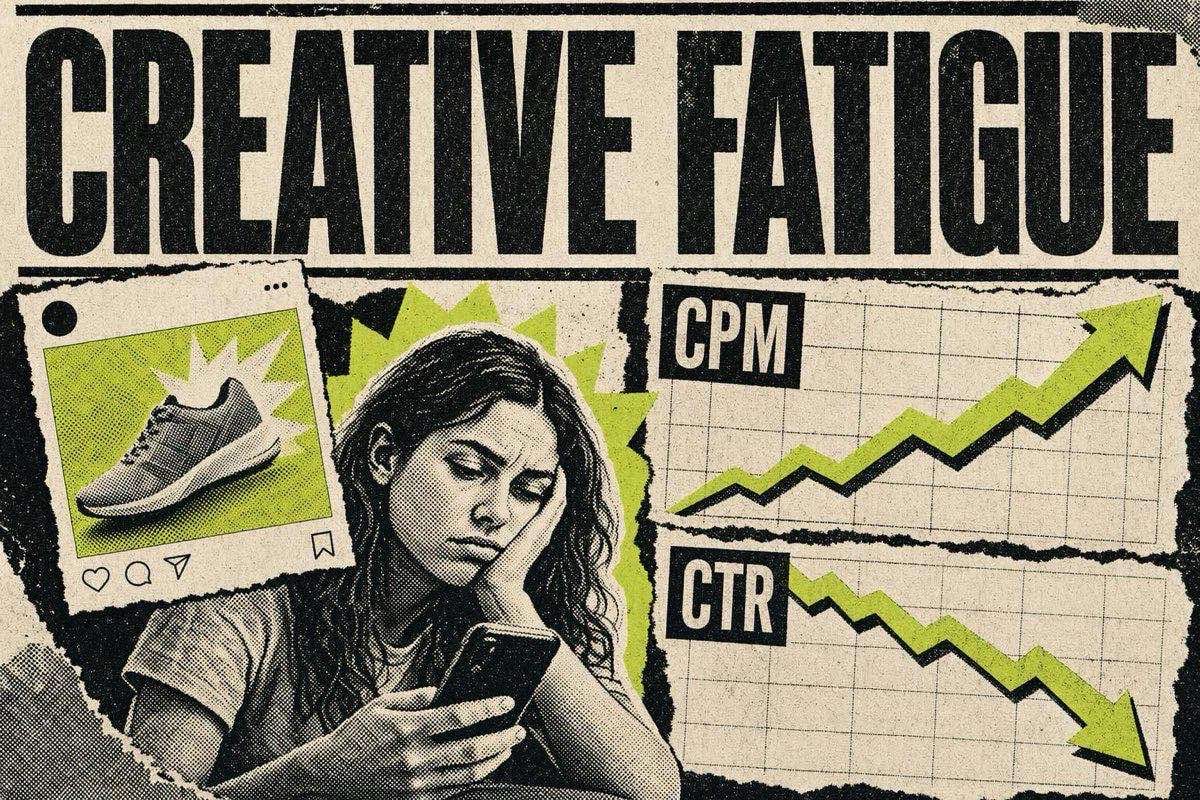
Creative fatigue is when the same ad stops converting the same audience
Creative fatigue on Facebook ads happens when your audience has seen the same creative enough times that it stops earning attention, showing up as CTR sliding down and CPM or CPA sliding up on a creative that used to perform. It isn't caused by the algorithm turning against you. It's caused by frequency, the number of times the average person in your audience has seen that specific ad, climbing past the point where the hook still lands.
The fix isn't complicated once you know what to watch and when to swap creative. This covers how to actually detect fatigue (not just guess at it), what frequency thresholds matter, how often to refresh, and how many variants to keep running so you're never caught flat-footed when one dies.
How to actually detect creative fatigue

Frequency is the leading indicator, not the cause. Meta defines frequency as your total ad impressions divided by reach, the average number of times each person in your audience has seen your ad, and it's added to your reporting view under Ads Manager's Customize Columns menu. It correlates with fatigue, but a high frequency number alone doesn't confirm it. A creative sitting at frequency 3.0 can already be fatigued if its CTR has dropped 40% from its own peak, while a different creative at frequency 5.0 might still be converting fine if engagement hasn't moved. Track frequency alongside performance, not instead of it.
Watch these together, not frequency alone, per the detection thresholds used by performance teams and documented in Madgicx's fatigue-detection breakdown:
- Frequency climbing past 3 to 4 for a cold (prospecting) audience, or past 8 to 10 for a retargeting audience, is the warning zone.
- CTR dropping 20% or more over two weeks on the same creative is the confirmation, not just a warning.
- CPA creeping up while frequency rises and CTR falls is the combination that means it's time to swap, not just monitor.
- Ad Relevance Diagnostics slipping (quality ranking, engagement rate ranking, conversion rate ranking, whichever Meta shows for your objective) alongside the above is a fourth confirming signal.
Pull a frequency distribution report to see the real spread, not just the average. In Ads Manager, go to Reports, create a custom report, and add frequency distribution alongside CTR and CPA columns. The account-level average frequency can look fine at 2.5 while a meaningful chunk of your audience has already seen the ad 6+ times. If more than 15% of your reached audience is at 5+ impressions on one creative, plan the refresh now, don't wait for the average to catch up.
Compare a creative to its own baseline, not to other ads. The most reliable fatigue signal is a creative's current CTR against its own week-one or week-two peak, because absolute CTR varies enormously by category and placement. A 40% drop from a creative's own best week is the number that matters, not whether it's "good" CTR in some general sense.
What rotation cadence actually works
There's no single universal number of days, because fatigue speed depends on audience size and daily reach, not the calendar. A creative reaching a 50,000-person retargeting audience burns through frequency far faster than the same creative reaching a 2-million-person cold audience. That said, a workable default for most D2C accounts:
- Cold prospecting creative: review weekly, expect meaningful fatigue signals somewhere between 2 to 4 weeks of steady spend, sooner if daily budget is high relative to audience size.
- Retargeting creative: review twice weekly, since smaller audiences hit high frequency much faster, sometimes within days on an aggressive retargeting budget.
- Broad/Advantage+ audience creative: slower to fatigue because Meta's delivery spreads impressions across a much larger pool, but still worth a weekly frequency check.
The practical rule: don't wait for a scheduled refresh date, wait for the frequency-plus-CTR combination described above, and have the next creative ready before you need it. A rotation calendar that assumes "refresh every 3 weeks" regardless of what the data says will either pull working creative too early or leave a dying creative running too long.
How many variants to keep in rotation
Running a single hero creative per ad set is the fastest way to hit fatigue hard, because 100% of your spend and audience overlap concentrates onto one asset. A more resilient setup keeps 3 to 5 active creative variants per ad set at any time, ideally testing different hooks or opening frames rather than just different end cards, so that when one variant's frequency climbs into the danger zone, the ad set's overall delivery can lean on the others while you prep a fresh batch.
This is also where dynamic creative differs from manual rotation: Meta's dynamic creative tool tests combinations of your uploaded assets automatically and can partially self-manage fatigue by shifting delivery weight away from combinations that are wearing out, but it still needs fresh source assets fed into it periodically. Automated mixing doesn't create new hooks, it just recombines what you've given it.
Build the next batch before you need it. The teams that handle fatigue best treat creative production as a standing weekly process, not a reactive one. Have 2 to 3 new hook concepts scripted and ready to go into testing before the current top performer shows its first frequency warning sign, so the swap is instant instead of a scramble.
FAQ

What frequency is too high for Facebook ads?
For cold, prospecting audiences, frequency above 3 to 4 is a warning sign. For retargeting audiences, which are smaller and see ads more often by design, frequency of 8 to 10 is more typical before fatigue sets in. Always read frequency alongside CTR and CPA, since frequency alone doesn't confirm fatigue.
How do I know if my Facebook ad creative is fatigued versus just a bad ad?
Compare current performance to that same creative's own peak week, not to other ads. A creative that's dropped 20% or more in CTR over two weeks, with frequency climbing and CPA rising at the same time, is fatigued. An ad that never performed well from day one is a different problem: a weak hook, not fatigue.
How often should I refresh Facebook ad creative?
There's no fixed universal number of days. Cold-audience creative typically shows fatigue signals somewhere between 2 to 4 weeks; smaller retargeting audiences can fatigue within days. Watch the frequency-plus-CTR combination instead of refreshing on a fixed calendar.
Does dynamic creative fix fatigue automatically?
Partially. Meta's dynamic creative tool can shift delivery weight away from combinations that are underperforming, which softens fatigue, but it only recombines the assets you upload. It doesn't generate new hooks on its own, so you still need fresh creative fed into it on a cadence.
How many ad creatives should I run at once per ad set?
3 to 5 active variants per ad set is a reasonable range for most D2C accounts. Running only one hero creative concentrates all your frequency onto a single asset and hits the fatigue wall faster; too many more than 5 can fragment budget across variants before Meta's delivery algorithm has enough data on any single one.
Keep a fresh batch ready, not a reactive one
The teams that never scramble on fatigue are the ones with the next batch of hooks already scripted before the current winner starts slipping. Pull your next round of angles from our 1,500+ AI prompt library, turn them into testable scripts fast with the free AI Hook Generator or AI Ad Copy Generator, and check our ad hook examples roundup for real hooks worth adapting. The newsletter sends one new winning hook breakdown every week if you want a steady stream of fresh angles without doing the research yourself.
The AI Ad-Making Kit
$99Make hyperreal AI video and image ads for any brand, with free AI tools. No camera, no agency.
- 10 modules
- 300+ hooks
- 500+ prompts
Canva ad templates, free.
Proven D2C ad layouts. Swap in your product, export, launch.
Browse templates →Want to act on what you just read?
Browse 3,400+ free, Canva-ready ad templates sorted by industry. One click to open, five minutes to customise.
Browse Free Templates