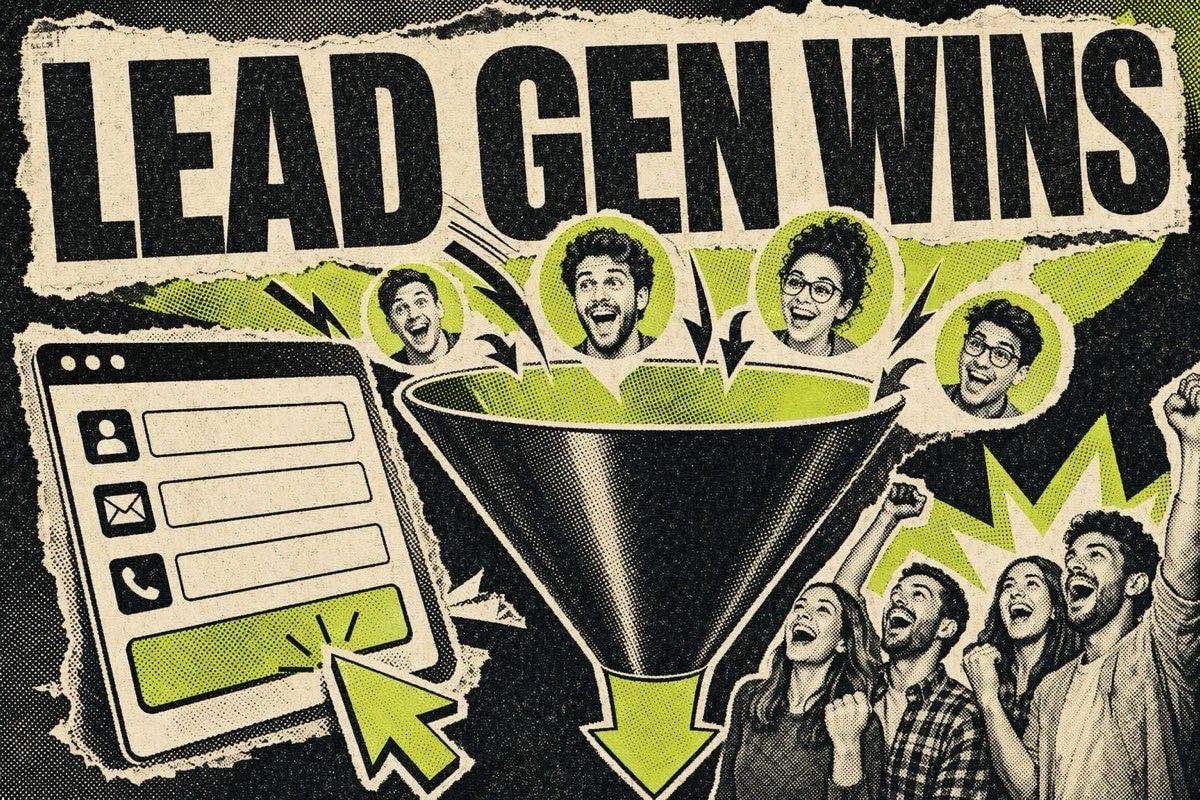
Lead generation Facebook ads work differently than sales ads, and most marketers brief them the same way
Lead generation Facebook ads use Meta's Instant Forms to collect a name, email, or phone number without the person leaving the platform. That's the entire mechanical advantage: no landing page load, no extra tap, just a form that pre-fills with the person's Facebook profile data. But the format only works if the offer and the qualifying questions are built for volume-with-quality, not copied from a direct-response sales ad. Here's how the format works, examples by industry, and the copy angles that actually move a stranger to fill out a form.
How Instant Forms actually work
When someone taps a lead-gen ad, Meta opens a native form instead of sending them to a website. Fields like name and email typically pre-fill from the person's Facebook or Instagram profile, which is the entire reason completion rates run higher than an off-platform landing page: there's less to type and no page-load friction.
Meta gives you two form types to choose from, and picking the wrong one for your goal is the single most common lead-gen mistake:
- More Volume forms use fewer fields and are optimized purely for completion rate. Use this when you want the highest number of raw leads and plan to qualify them downstream (a follow-up call, an email sequence, a nurture flow).
- Higher Intent forms add a confirmation screen and support custom qualifying questions (budget, company size, timeline). These see lower completion rates but the leads that do come through tend to be more sales-ready.
Neither is universally better. A local service business running a $50 promo wants More Volume. A B2B SaaS company selling a $30,000 annual contract wants Higher Intent, every time, even at a lower volume.
Meta documents both form types and their setup in its guide to lead ads with Instant Form, including how to choose between More Volume and Higher Intent and how to add custom qualifying questions. It's worth reading once before you build your first form, since the field order and question phrasing both affect completion rate in ways that aren't obvious from the ad preview alone.
Lead-gen examples by industry

Real estate
Real estate lead-gen ads perform best around a specific, tangible offer: "See homes in [neighborhood] before they hit the market" or a downloadable local buyer's guide, rather than a generic "contact an agent" ask. The form collects contact details plus one qualifying question (buying timeframe, budget range) so the agent isn't cold-calling someone who's a year out from actually buying.
Home services (roofing, HVAC, solar, remodeling)
This category leans on a free-estimate or inspection offer, almost always paired with a before/after visual of the actual work. The form typically asks for property type or zip code as a qualifying field, since these businesses operate in defined service areas and a lead outside that radius is wasted spend.
B2B SaaS and professional services
B2B lead-gen ads convert best around a specific deliverable, a template, a benchmark report, a free audit, rather than "book a demo" cold. The Higher Intent form format is standard here, with 2 to 3 qualifying questions (team size, current tool, budget band) that let sales prioritize the queue instead of working every lead in order received.
Financial services and insurance
This category runs on calculators and quote tools framed as the lead magnet ("see your rate in 60 seconds"), collecting enough detail upfront (coverage type, rough budget) that the follow-up call starts from a qualified position instead of a cold intro.
Education, courses, and webinars
Course and webinar lead-gen ads perform around a specific date or cohort ("next cohort starts [date], 12 spots left") rather than an evergreen "learn more." The specificity creates a natural reason to act now instead of bookmarking it for later.
Local services (salons, gyms, clinics)
Local lead-gen ads work best around a first-visit offer (a free consultation, a trial class, a first-session discount) paired with location and hours info directly in the form flow, since the decision being asked of the viewer is "will I actually go," not just "am I interested."
Across every one of these categories, the common thread is the same: the form works best when it's collecting interest in something concrete and time-bound, not testing general awareness. A vague "learn more about our services" form consistently underperforms a specific, dated, or location-bound offer, regardless of industry.
What makes a lead magnet actually convert
The offer matters more than the form design. A weak offer with a perfectly optimized form still underperforms a strong offer with a clunky one.
- Specific over generic. "Free consultation" undersells. "Free 15-minute pricing walkthrough for a 3-bedroom roof" oversells nothing and still converts better, because it removes the guesswork about what happens after the click.
- Immediate value, not a sales call in disguise. If the "free guide" is actually just a pretext to get someone on the phone with a salesperson, completion rates and lead quality both suffer once word gets around (and it does, in reviews and comments).
- One qualifying question, chosen deliberately. Every extra field trades completion rate for lead quality. Pick the one question that actually changes how your sales team prioritizes the lead, and skip the rest.
- A visible reason to act now. A cohort date, a limited number of estimate slots, a seasonal window. Evergreen offers with no urgency see the weakest form-start rates of any lead-gen category.
Instant Forms vs. landing pages: pick based on what happens after the click
This is the trade-off most briefs skip entirely. Instant Forms reduce the time to complete from roughly two minutes down to about 20 seconds and typically generate more raw leads at a similar cost per lead compared to sending traffic to an external landing page, because there's no page load and fields pre-fill automatically.
But raw lead volume isn't the same as lead quality, and the gap between the two formats can be significant. In practice, Lead Ad-sourced contacts tend to convert to actual appointments at a noticeably lower rate than landing-page-sourced contacts, because the landing page requires more active intent (typing your own details into an external form) than tapping through a pre-filled native form. That doesn't make Instant Forms the wrong choice, it makes them the right choice for a different goal: use Instant Forms when volume and low cost-per-lead matter most and you have a strong follow-up process to qualify fast. Use a landing page when lead quality per contact matters more than raw count and your sales capacity is limited.
Value-based lead optimization, not just volume
Meta's ad delivery system can optimize toward lead volume, or it can optimize toward lead value if you feed it data on which leads actually closed. If you have even a few months of historical data showing which lead sources or segments turned into real customers, uploading that value data lets the algorithm chase more of what converted, not just more of what filled out a form. This shift matters most for businesses with a wide range in lead quality, like B2B SaaS or financial services, where a "lead" can be worth $50 or $50,000 depending on who they are. Skipping this step and optimizing for raw volume alone is one of the more common reasons a lead-gen account looks great on cost-per-lead and terrible on actual revenue.
Getting leads into your CRM fast
Speed to follow-up is the single biggest lever most lead-gen accounts leave on the table. A lead sitting in Meta's Ads Manager dashboard for six hours before anyone calls has already cooled off. Meta's own documentation on CRM system integrations for lead ads covers connecting Instant Forms directly to a CRM via a native integration or a third-party connector like Zapier, so a new lead triggers an immediate email and queues a same-day call instead of sitting in an exported spreadsheet. This one operational fix moves lead-to-close rates more than almost any creative change.
Writing the ad itself

The form does the collecting, but the ad still has to earn the tap. Lead the ad with the specific outcome the qualifying field maps to ("see homes before they list," "get your roof estimate this week"), not a generic company description. If you need a starting point for that opening line, our free AI Hook Generator builds hook variations around a specific offer, and the facebook ad headline generator does the same for the headline that sits above your form CTA.
For the body copy underneath the hook, our ad hook formulas for e-commerce piece and facebook ad headline templates roundup both have structures that adapt cleanly to a lead-gen offer, not just a straight product sale. And before you brief a new lead-gen creative, it's worth checking the Meta Ads Library for what competitors in your category are currently running, since lead-gen creative in a given vertical tends to cluster around 2 or 3 proven offer types.
FAQ
What is a lead generation ad on Facebook?
A lead generation ad uses Meta's Instant Forms to collect contact information (name, email, phone) directly inside Facebook or Instagram, without sending the person to an external website. Fields typically pre-fill from the person's profile, which reduces friction compared to a landing page form.
Are Facebook lead ads better than sending traffic to a landing page?
It depends on your goal. Lead ads generally produce more raw leads at a lower cost per lead because there's less friction to complete the form. Landing pages typically produce fewer, more qualified leads, since typing details into an external page requires more active intent than tapping a pre-filled native form.
How many questions should a lead-gen form ask?
As few as possible while still capturing what changes your follow-up priority. Most high-performing forms use one to three fields beyond name and contact info. Every additional question reduces completion rate, so each one should earn its place.
What industries perform best with Facebook lead ads?
Real estate, home services (roofing, HVAC, solar), financial services, B2B SaaS, education and webinars, and local services (salons, gyms, clinics) all use the format heavily because each has a clear, specific offer that maps to one qualifying question.
How fast should I follow up with a Facebook lead-gen lead?
As close to immediately as your process allows. Leads sitting unaddressed for hours convert far less often than leads contacted within minutes. Connecting your lead form directly to a CRM so a new submission triggers an instant email and same-day call is the highest-leverage fix most accounts are missing.
Turn your next lead-gen brief into a working ad
A specific offer, one smart qualifying question, and a fast follow-up beat a bigger budget every time. Start your next hook with our 1,500+ free AI prompt library and browse real ad teardowns for lead-gen angles that are already working, plus one new winning hook breakdown every week in the newsletter.
The AI Ad-Making Kit
$99Make hyperreal AI video and image ads for any brand, with free AI tools. No camera, no agency.
- 10 modules
- 300+ hooks
- 500+ prompts
Canva ad templates, free.
Proven D2C ad layouts. Swap in your product, export, launch.
Browse templates →Want to act on what you just read?
Browse 3,400+ free, Canva-ready ad templates sorted by industry. One click to open, five minutes to customise.
Browse Free Templates