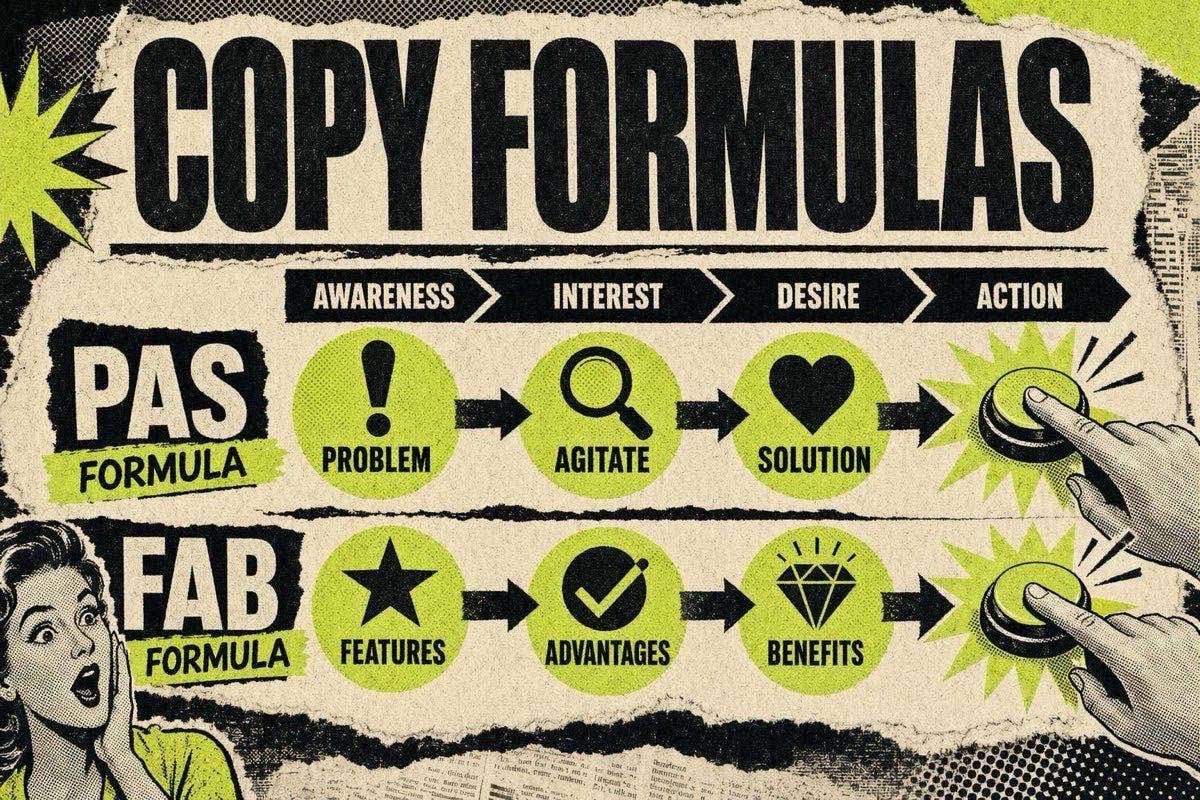
Three ad copy formulas cover almost every high-performing ad you'll ever write: PAS (Problem-Agitate-Solution) for cold traffic with a felt problem, AIDA (Attention-Interest-Desire-Action) for longer-form or awareness-stage copy, and FAB (Features-Advantages-Benefits) for considered purchases where the buyer needs to understand what the product actually does. Below is each formula with a full worked example, then a decision framework for which one fits your funnel stage and product type.
None of these are theory. They're the same three structures behind most scaling ad copy in Meta's Ad Library right now, they're just rarely named out loud in the ad itself. Once you can see the skeleton, you can write ten variations of any of them in the time it used to take to write one.
Why Ad Copy Formulas Work Better Than Writing From Scratch
Blank-page copywriting fails for a specific reason: without a structure, most people default to describing the product instead of making the reader feel something first. A formula forces sequence. PAS forces you to sit in the problem before you're allowed to sell. AIDA forces you to build desire before you ask for the click. FAB forces you to translate a spec sheet into a reason to care.
That sequencing matters more on paid social than almost anywhere else in marketing, because the reader hasn't asked for your ad. They're mid-scroll. A formula is a shortcut to the psychological order that gets someone from "not thinking about this" to "add to cart" without skipping a step their brain needs.
This is also why swapping formulas mid-test is a legitimate testing variable, not just a copywriting exercise. Two ads selling the same offer with different formulas often perform completely differently depending on the audience's temperature, which is the whole second half of this post.
The PAS Formula (Problem-Agitate-Solution)

PAS is the tightest of the three and the one most native to short-form paid social copy, because it front-loads a felt problem instead of a product pitch.
Structure:
- Problem: name the specific pain the reader already has
- Agitate: make the cost of that pain concrete and immediate
- Solution: introduce your product as the fix, with enough specificity to feel credible
Worked example: a mattress-in-a-box brand
- Problem: "You wake up with a stiff lower back every single morning."
- Agitate: "It's not your posture. It's a mattress that stopped supporting your spine two years ago and you kept sleeping on it anyway, because replacing it felt like a hassle you didn't have time for."
- Solution: "Purple's gel-grid foam adjusts to your spine in real time, no more waking up to fix it yourself. Ships in a box, sleep on it for 100 nights, send it back free if it's not the one."
The agitate line is doing the real work. It's not just restating the problem louder, it's adding a reason the problem persists ("kept sleeping on it anyway") that makes the reader nod before they've consciously agreed to anything. Purple ran exactly this kind of problem-first creative at scale, memorably the "raw egg drop test" video, which we break down in the static ads vs video ads comparison.
When PAS wins: cold-audience, top-of-funnel ads for products that solve an ongoing annoyance the buyer already recognizes (skin issues, back pain, slow work processes, embarrassing recurring costs). It's the fastest formula to write a strong first line for, which is why it shows up constantly in the 25 Facebook ad hook examples breakdown, most of those hooks are just PAS compressed into one sentence.
The AIDA Formula (Attention-Interest-Desire-Action)
AIDA is the oldest of the three, first documented in sales copy over a century ago, and it's built for longer copy where you have room to build a case instead of landing one gut-punch line.
Structure:
- Attention: a hook strong enough to stop the scroll or the read
- Interest: a reason this applies specifically to the reader
- Desire: proof, specificity, or a vivid outcome that makes them want it
- Action: a direct, specific instruction on what to do next
Worked example: a SaaS project management tool
- Attention: "Your team missed another deadline this week. Here's why it wasn't their fault."
- Interest: "Most project delays don't come from slow work, they come from unclear ownership. If three people think someone else is handling a task, nobody does."
- Desire: "Teams using Asana-style ownership views cut missed handoffs by making 'who owns this' visible on every task, not buried in a Slack thread from two weeks ago. Marketing teams running this report shipping campaigns 20% faster on average."
- Action: "Start your free 14-day trial. No card required, see your first week's ownership map in under 10 minutes."
Notice AIDA has a full extra beat that PAS doesn't: Interest is a separate step from Attention, which gives you room to qualify the reader before you ask them to feel desire. That extra step is exactly why AIDA suits longer primary text and landing pages better than a 3-second video hook, there's more real estate to earn.
When AIDA wins: primary-text-heavy Facebook feed ads, landing page copy, and email, anywhere the reader has already opted into reading more than one line. It also suits considered B2B and SaaS purchases where the buyer needs a coherent argument, not just an emotional jolt.
The FAB Formula (Features-Advantages-Benefits)
FAB is the formula most marketers get wrong, because most people stop at Features or Advantages and never translate all the way down to Benefits, which is the only layer that actually persuades.
Structure:
- Feature: what the product literally has or does
- Advantage: what that feature technically enables
- Benefit: what that means for the reader's actual life, in their language
Worked example: a portable espresso maker
- Feature: "18-bar pump pressure and a built-in heating element."
- Advantage: "That means it pulls a real espresso shot with crema, not instant coffee, without being plugged into an outlet."
- Benefit: "You get an actual espresso on a campsite, in a hotel room, or at your desk at 6am before anyone else is up, the same shot you'd pay $5 for, made in 90 seconds with water you already have."
The mistake almost every ad makes is stopping at "Advantage" and calling it done. "18-bar pump pressure" (feature) into "pulls a real espresso shot" (advantage) sounds like enough information, but it still requires the reader to do the work of imagining why that matters to them. The Benefit line does that work for them.
When FAB wins: considered purchases where the buyer is comparing specs against competitors (electronics, appliances, tools, software with a feature comparison table) and for retargeting ads to someone who's already interested but hasn't converted, because by that stage they need the "why this over the other one," not another emotional hook.
PAS vs AIDA vs FAB: Which One to Use When
The formula that works is a function of two variables: funnel stage and product type, not personal preference.
- Funnel stage — Best formula — Why
- Cold, top-of-funnel — PAS — Fastest path to a felt problem in a 3-second hook
- Mid-funnel, engaged but not converted — AIDA — Room to build a full case with proof and specificity
- Bottom-funnel, retargeting, comparison shopping — FAB — Buyer needs concrete reasons, not another emotional hook
- Product type — Best formula — Why
- Impulse / emotional (beauty, fashion, home goods) — PAS — The problem is felt, not researched
- Considered / high-price (SaaS, furniture, electronics) — AIDA or FAB — Buyer needs a case built, not just a feeling
- Spec-heavy / technical (tools, appliances, software features) — FAB — Advantage-to-benefit translation is the actual selling job
A practical rule that holds up across most e-commerce and D2C accounts: use PAS for the hook, then finish the ad with a FAB-style proof point. The opening line stops the scroll with a problem, the closing line answers "okay but why this exact product" with a concrete benefit. That two-formula stitch is more common in real scaling ads than any single formula run start to finish, most 15-second video ads are structurally PAS-into-FAB whether the person who wrote them knew the acronyms or not.
A Fast Way to Test All Three Without Writing From Scratch

Instead of manually drafting three full versions of the same ad, run your offer through all three formulas at once and compare which sequencing feels strongest for your specific product. The AI ad copy generator does exactly this: give it your product and audience, it outputs a PAS version, an AIDA version, and a FAB version so you can see the same offer through three structural lenses in under a minute, then pick the one (or the stitched combination) that fits your funnel stage.
Pair whichever formula you land on with a headline built the same way, the Facebook ad headline templates post has 15 you can adapt, and if the copy is heading into a video script rather than a static, the opening line matters even more than usual, see how to write intro hooks for video ads for 30 concrete openers.
FAQ
What is the difference between PAS and AIDA?
PAS (Problem-Agitate-Solution) is a three-step formula built for short, punchy copy that leads with a felt problem. AIDA (Attention-Interest-Desire-Action) has an extra step and more room to build a case, which makes it better suited to longer primary text, landing pages, and email than a 3-second video hook.
Which ad copy formula converts best?
None of the three formulas is universally best, conversion depends on funnel stage and product type. PAS wins for cold traffic and impulse products, AIDA wins for considered purchases with room for a longer argument, and FAB wins for retargeting and spec-heavy products where the buyer needs concrete reasons over another emotional hook.
Can you combine PAS and FAB in one ad?
Yes, and it's common in scaling e-commerce ads even when the writer never named the formulas. Open with a PAS-style problem to earn attention, then close with a FAB-style benefit line that gives a concrete reason to buy this specific product over a competitor.
What is the FAB formula in marketing?
FAB stands for Features, Advantages, Benefits. It's a three-layer translation: state what the product has (feature), what that technically enables (advantage), then what that means for the reader's actual life (benefit). Most copy fails by stopping at Advantage instead of finishing the translation to Benefit.
Do these formulas work for video ad scripts, not just text?
Yes. PAS maps directly onto a video's opening hook plus problem statement, AIDA maps onto a longer UGC-style testimonial script with a build-up, and FAB works well for demo-style video ads that need to show a feature and explain why it matters. The formula is about sequencing ideas, not the medium.
Pick the formula that matches your funnel stage, then generate real variations instead of staring at a blank draft: the AI ad copy generator writes PAS, AIDA, and FAB versions of your offer in one pass, and the free AI prompt library has 1,500+ prompts for the visuals to go with them. Get one new winning ad breakdown in your inbox every week when you join the newsletter.

The AI Ad-Making Kit
$99Make hyperreal AI video and image ads for any brand, with free AI tools. No camera, no agency.
- 10 modules
- 300+ hooks
- 500+ prompts
Canva ad templates, free.
Proven D2C ad layouts. Swap in your product, export, launch.
Browse templates →Want to act on what you just read?
Browse 3,400+ free, Canva-ready ad templates sorted by industry. One click to open, five minutes to customise.
Browse Free Templates