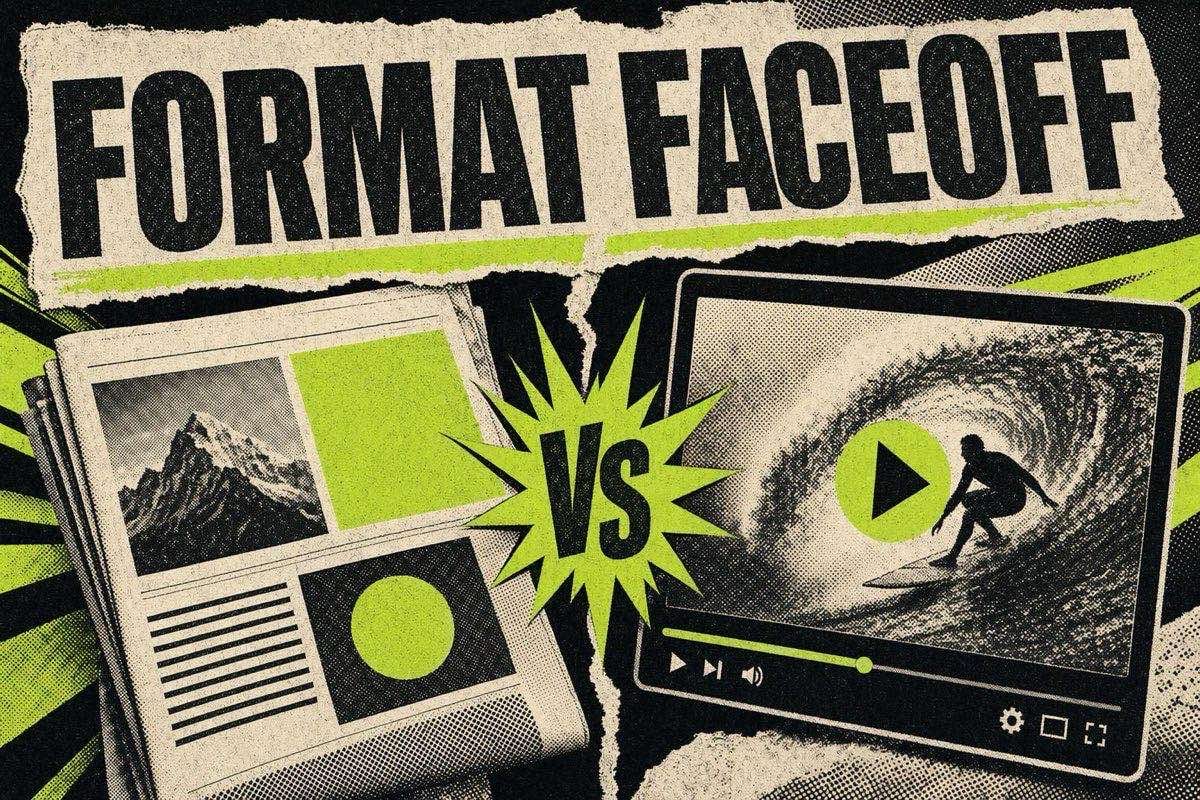
The short answer: static ads win when the message lands in a single frame, think retargeting, offers, price anchors, and fast creative testing. Video ads win when the product needs demonstration or the audience needs a story, think cold traffic, high-consideration purchases, and Reels inventory. Most accounts should run both, assigned by funnel stage.
"Which performs better" is the wrong question, and it is why so many media buyers get a useless answer. Format is a delivery mechanism. The hook, the offer, and the match between message and funnel stage decide the outcome. This guide gives you the decision framework: when static wins, when video wins, and how to test the two against each other without torching your budget.
What Counts as a Static Ad
A static ad is a single, non-moving image served as paid media: one frame, one message, no timeline. On Meta that covers single-image feed ads, right column ads, and the individual cards inside a carousel. A static post is the organic cousin, the same still image published to your feed instead of promoted through Ads Manager.
The category is broader than "product photo with a logo." High-performing static formats include:
- Text-heavy "ugly" ads that look like a note or a screenshot
- Us-vs-them comparison graphics with a two-column table
- Testimonial cards built around one customer quote
- Press-style headlines that mimic an article screenshot
- Before/after splits in a single frame
If you want to see these dissected frame by frame, the ad teardowns library breaks down real static and video ads by hook, mechanism, and why they worked.
Video ads cover everything with a timeline: UGC-style talking heads, product demos, animated statics, and full-screen 9:16 Reels creative.
Static Ads vs Video Ads: What the Published Data Says
Here is the honest version: there is no credible public dataset proving one format beats the other across the board. Most "video gets 27% higher CTR" claims floating around agency blogs cite no methodology, no sample size, and no date. Treat them as decoration.
What has actually been published:
- Databox surveyed 95 marketers on this exact question. 67.55% said video drives more ad clicks on Facebook, 26.47% said images, and 5.88% saw no difference. But the same survey carries the nuance most people skip: several respondents reported image ads beating video on CTR, CPC, and cost per conversion in direct-response campaigns, with video reserved for top-of-funnel awareness.
- WordStream's Facebook ads benchmarks, based on campaigns from February 2023 through April 2024, put the average CTR at 1.57% for traffic campaigns and 2.53% for lead campaigns. Those numbers blend all formats, which is exactly the point: your creative either clears the benchmark or it does not, and the format alone will not get you there.
- Meta's own ads guide is format-agnostic on performance but not on placement. Reels and Stories are built for 9:16 video. Right column is image-only. The auction will happily take your money either way.
One more reason to distrust universal answers: survey data describes other people's accounts, not yours. A skincare brand selling on demonstration and a SaaS tool selling on a single stat will get opposite results from the same format split. Published data sets your priors; your own test results overwrite them.
The pattern practitioners keep reporting: video tends to earn attention and cheaper reach, statics tend to convert it. Which brings us to the actual decision.
When Static Ads Win

The message fits in one frame
Offers, discounts, restocks, "last day" urgency, a single killer stat. If a person can absorb the whole pitch in under two seconds, a video only adds friction. A "40% off ends tonight" message does not need a script, a hook, and an edit. It needs big type and contrast.
Retargeting and bottom of funnel
Warm audiences already know the product. They do not need a 30-second demonstration; they need a reason to come back. Testimonial cards, objection-handling graphics ("free returns, seriously"), and straight offer statics are the workhorses of retargeting. This is where the Databox respondents saw images beating video on cost per conversion.
You need testing velocity
A designer, or a decent AI image workflow, can produce ten static variations in the time it takes to script one video. That matters because creative testing is a volume game: more distinct angles tested per week means faster learning about what your market responds to. If you are testing hooks, headlines, and visual concepts, statics are the cheapest lab you will ever run. The free AI ad tools and prompt library exist for exactly this loop.
The placement demands it
Right column inventory is image-only and desktop-only. Feed placements render a 4:5 static at full quality with zero production risk. If your media plan leans on cheap feed and right column impressions, statics are not a compromise, they are the native format.
When Video Ads Win
The product needs demonstration
Anything where the "aha" is visual and sequential: a cleaning product cutting through grime, an app's three-tap workflow, a garment moving on a real body. One frame cannot show change over time. Video can, and for these products the demo IS the hook.
Cold audiences need a story
A stranger has no reason to care about your brand. Video buys you a narrative arc: problem, agitation, mechanism, proof, offer. UGC-style creator videos carry this load better than any static because they borrow the grammar of organic content. If that is your lane, the UGC ads guide covers the full production and briefing process.
You are buying Reels and Stories inventory
Reels on Instagram and Facebook are full-screen 9:16 placements where users expect motion and sound. A static in that environment announces itself as an ad instantly. Meta's ads guide treats Reels as a video-first surface and recommends designing for sound on. If Reels is where your audience scrolls, video is the price of admission. Get the dimensions right too: the Facebook ad sizes cheat sheet lists every placement spec and safe zone.
The offer needs trust before the click
High-consideration or skepticism-heavy products (supplements, financial apps, anything over $100) convert better when a human face does the explaining. A talking-head video with a strong first three seconds builds more trust per impression than any graphic.
The Four-Question Decision Framework
Run every campaign through these four questions before you brief a single asset.
- Question — Points to static — Points to video
- 1. Funnel stage? — Warm retargeting, bottom of funnel — Cold prospecting, top of funnel
- 2. Does the product need demonstration? — No, the value is instantly clear — Yes, the "aha" is visual or sequential
- 3. Production and testing capacity? — Small team, need 10+ variations weekly — Budget for scripting, filming, editing
- 4. Placement mix? — Feed, right column, Marketplace — Reels, Stories, in-stream
Scoring is simple: three or four answers in one column tells you where the next brief goes. A split of two and two means you run both, and the budget follows whichever format hits your CPA target first.
One more constraint worth naming: money. Static ads cost almost nothing to produce, so a low-budget account gets more shots on goal by starting static, finding a winning angle, and only then paying to turn that proven angle into video. Producing video first, on an unproven angle, is the most expensive way to learn your hook is weak.
What This Looks Like in a Real Media Plan
Take a D2C brand spending a modest monthly budget on Meta with one media buyer and no in-house video team. A sensible default allocation:
- Prospecting (60% of spend): two UGC-style videos carrying the story for cold audiences on Reels and feed, refreshed monthly, plus two statics of the strongest single-frame claim as cheap coverage.
- Retargeting (30% of spend): statics only. One testimonial card, one objection-handler, one straight offer. Rotate weekly, produce in batches.
- Testing (10% of spend): five new static angles per week against the current control. Whichever angle wins twice gets a video treatment next month.
The ratio is not sacred. The principle is: video where strangers need convincing, statics where the message is already understood, and a permanent cheap testing lane feeding both.
How to Test Static vs Video Without Burning Budget

The classic mistake is testing a great video against a lazy static and concluding "video wins." Test the format, not the effort gap.
- Fix the angle. Pick one proven hook or claim, the same one for both formats. If you do not have one yet, generate candidates with the free hook generator and shortlist three.
- Produce matched creative. Three static executions and one video execution of the same angle. Same headline logic, same offer, same CTA.
- Split evenly. One campaign, separate ad sets or a proper A/B test in Ads Manager, equal budget, same audience. Let Meta's delivery do its job for at least a full week or 50 conversions per arm, whichever comes first.
- Judge on CPA, not CTR. Video routinely wins clicks and loses on cost per purchase. The metric that pays your bills is the tiebreaker.
- Iterate the winner's format faster. If static wins, ship five new statics next week. If video wins, cut three new openings for the same video before reshooting anything.
Repeat monthly. Accounts drift, audiences fatigue, and last quarter's answer expires.
FAQ
Are static ads cheaper to produce than video ads?
Yes, and the gap is large. Databox survey respondents put a typical image ad at about an hour of production versus several hours for a single video. That cost difference compounds in testing: the same budget buys far more static variations, which means faster learning per dollar spent.
Do static ads still work in 2026?
Yes. Static ads remain the standard for retargeting, offer promotion, and rapid creative testing on Meta. Feed, right column, and Marketplace placements render them natively, and practitioner surveys consistently report images beating video on cost per conversion in direct-response campaigns, even while video wins on clicks.
Should I use static or video ads for retargeting?
Static first. Warm audiences already understand the product, so testimonial cards, objection-handling graphics, and straight offers usually deliver a lower cost per purchase than video. Add one short video only if your retargeting pool is large enough to need format variety against creative fatigue.
What size should static ads be on Facebook?
Use 1080x1080 (1:1) as your universal static size, and 4:5 (Meta recommends 1440x1800) to claim more feed real estate on mobile. Stories placements need 9:16 with the bottom third kept clear of text. Full placement-by-placement specs, safe zones, and file limits are in our Facebook ad sizes cheat sheet.
The takeaway: stop asking which format is better and start assigning formats by job. Statics convert warm traffic and test angles cheaply; video earns cold attention and demonstrates products. The accounts that scale run both on purpose.
Steal what is already working before you brief anything: browse 1,500+ free AI ad prompts to produce your next batch of statics in an afternoon, and study the teardowns library to see why real static and video winners worked. Both are free.

The AI Ad-Making Kit
$99Make hyperreal AI video and image ads for any brand, with free AI tools. No camera, no agency.
- 10 modules
- 300+ hooks
- 500+ prompts
Canva ad templates, free.
Proven D2C ad layouts. Swap in your product, export, launch.
Browse templates →Want to act on what you just read?
Browse 3,400+ free, Canva-ready ad templates sorted by industry. One click to open, five minutes to customise.
Browse Free Templates