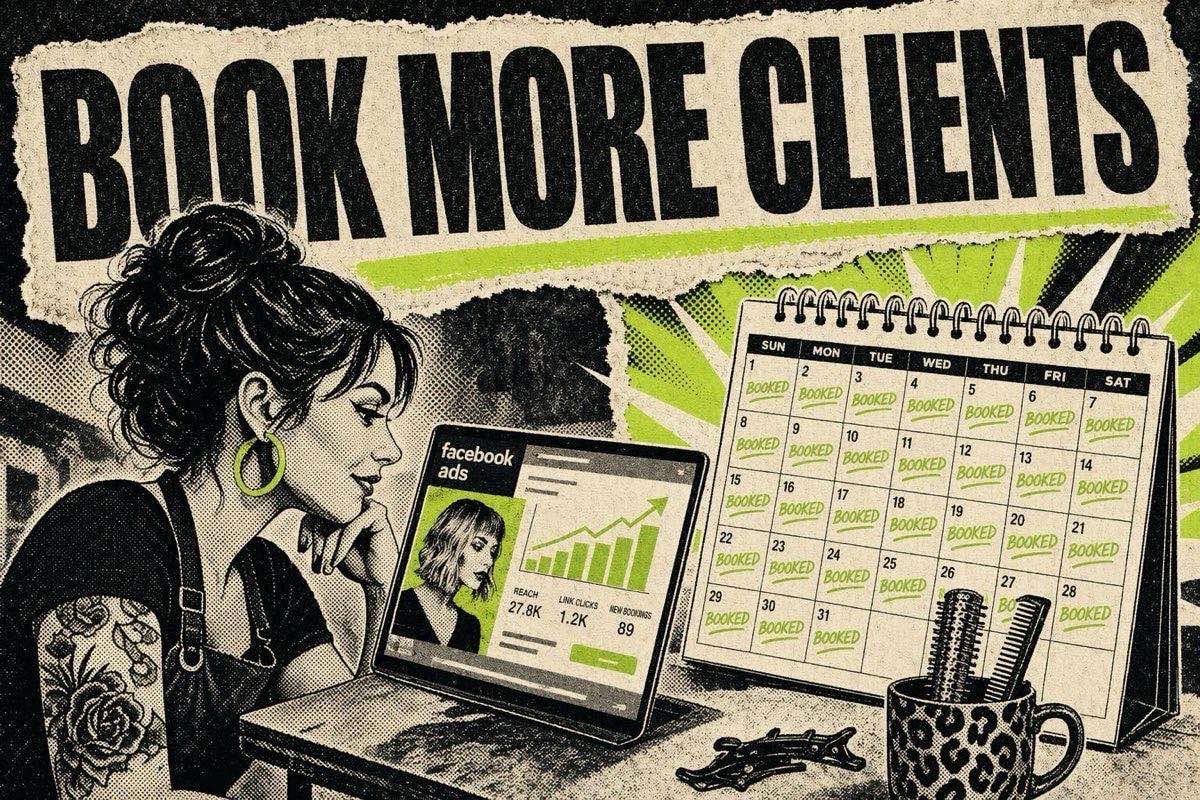
Salon Facebook ads that book clients share four traits: a booking-focused CTA (not "Learn More"), a real before/after or in-chair photo, a radius tight enough to only reach people who can actually walk in, and proof from reviews the salon already has sitting in Google. Below is the exact setup, angle by angle, for a local business trying to fill chairs, not chase brand awareness.
What Makes Salon Facebook Ads Different From Everything Else on Meta
Most Facebook ad guides are written for e-commerce, national reach, cart abandonment, product catalogs. None of that applies to a salon that only serves people within a 15-minute drive. A salon running a national-style ad wastes most of its budget on people who will never sit in a chair.
The fix starts with treating the ad like a local storefront sign, not a national brand campaign: the copy should assume the reader already lives nearby, the CTA should assume they're ready to pick a time, and the targeting radius should assume distance is the single biggest filter on whether this lead converts at all.
The Booking-Focused CTA (The Single Biggest Lever)
Swap "Learn More" for a CTA that asks for the booking directly:
- "Book Your Appointment" instead of "Learn More." Meta's own ad objectives include a dedicated conversion path for this, and using it (versus a generic traffic click) tells the algorithm to optimize toward people who actually book, not just people who click.
- Link straight to the booking widget, not the homepage. Every extra tap between the ad and a confirmed time slot loses a percentage of ready-to-book clients. If the salon uses Fresha, Vagaro, Booksy, or Square Appointments, the ad should deep-link to that specific service's booking page.
- Name the exact service, not the salon. "Book a balayage touch-up this week" converts better than "Book with [Salon Name]" because it matches the specific search intent the client already has in mind. The same headline logic that works for e-commerce, see 15 Facebook ad headline templates, applies here: specific beats generic every time.
A first-time visitor doesn't need to learn your brand story before booking a haircut. They need a fast, obvious path from "I saw this ad" to "I have an appointment," and cutting every unnecessary step between those two moments is the single most effective fix available.
Before/After Visuals: What Actually Works
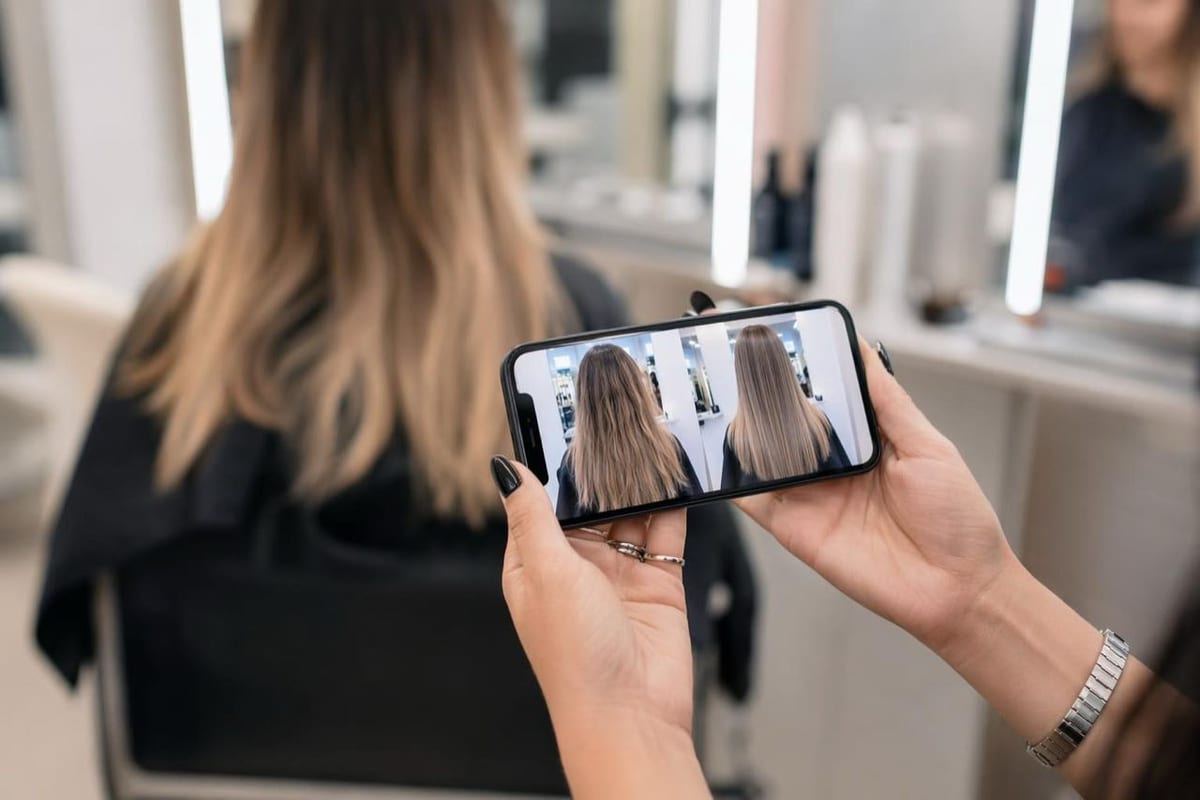
Before/after content is the single strongest creative format for salons and spas because it's the only format that shows the result instead of describing it. It's the same principle behind the strongest Facebook ad hook examples in any category: proof beats a claim, every time.
What works:
- Real clients, real lighting. A phone photo taken in the actual salon under the actual lighting reads as more credible than a polished studio shot, because it matches what the viewer expects their own result to look like.
- Consistent framing between before and after. Same angle, same distance, same background. If the framing changes, the viewer's brain works to compare and loses the impact.
- One before/after per ad, not a collage. A single dramatic result holds attention longer than a grid of six small results competing for the same two seconds of scroll time.
What to avoid:
- Stock photography of models that don't resemble the salon's actual clientele. It breaks trust the moment a local viewer notices the mismatch.
- Heavy filters or editing on the "after" photo. It reads as staged, and staged before/afters get called out in the comments, which is worse than not running the ad at all.
- Client photos without written consent. Always get explicit permission before using a client's face in paid media, not just a verbal okay.
Local Radius Targeting: Getting the Distance Right
Radius targeting is where most local ad budgets get wasted. Meta's location targeting for a single address defaults to broad settings that are rarely tight enough for a walk-in service business, US radius targeting can range from a 1-mile minimum up to 50 miles, and the default is almost never the right choice for a salon.
Start narrow and expand only if the budget can't spend:
- Urban salons: 2-3 miles. Population density means there are enough potential clients in a tight radius, and a wider radius mostly adds people who won't cross town for a haircut.
- Suburban salons: 5-8 miles. Clients are more willing to drive further when there are fewer options nearby, but past a certain distance the ad is reaching people who will choose a closer competitor instead.
- Rural or destination spas: 15-25 miles, sometimes wider if the business is a genuine destination (a day spa people plan a trip around, not a walk-in blowout bar).
One documented case study showed a local services campaign that narrowed its radius from 30 miles down to 8 miles, added tighter demographic filters, and saw lead volume rise 86% while cost per lead dropped 58% in the same market. Tighter isn't just cheaper, it's often more effective, because the algorithm stops spending impressions on people who were never going to book.
Seasonal Promos That Actually Fill Slow Weeks
Salons and spas have a predictable seasonal rhythm, and the ad calendar should match it instead of running the same static promo year-round:
- Pre-holiday (late November-December): blowouts, color refreshes, gift card promos. Book 2-3 weeks ahead of the peak so the calendar fills before the rush, not during it.
- Post-holiday slow season (January): "fresh start" positioning, new color, new cut, tied to the new year without leaning on tired resolution clichés.
- Prom and wedding season (spring): updo trials, group bookings for bridal parties, higher average ticket size makes this worth a dedicated campaign rather than folding it into general awareness ads.
- Summer: lighter color services, treatments for sun and chlorine damage, a natural angle for anyone doing hair or skin services in a warm climate.
The mechanism behind seasonal promos isn't just "timely," it's urgency with a real reason behind it. "Book your holiday blowout before the calendar fills" works because the deadline is genuinely true, salons do get fully booked in December, unlike a fake countdown timer with no real scarcity behind it.
Review-Based Social Proof: Turning Reviews Into Ad Creative
A salon with strong Google or Yelp reviews already has its best ad copy sitting in the reviews tab, most owners just never turn it into a creative:
- Screenshot the actual review, star rating and all, rather than retyping it as ad copy. The screenshot format signals authenticity the way retyped text doesn't.
- Pick reviews that mention a specific result, not just "great service!" A review that says "finally found someone who can do curly hair right" tells a specific story that a generic five-star rating doesn't.
- Pair the review with the stylist's name, if the client mentioned one. Local clients often choose a salon based on a specific stylist's reputation, not the brand as a whole, so naming names in the ad can matter more than naming the salon.
- Rotate reviews by service. A color-specific review works better next to a color promo than a generic review pulled at random, matching the proof to the specific service being advertised keeps the whole ad coherent.
Budget Reality for a Single-Location Salon
Local service ads don't need a large budget to generate meaningful bookings, but they do need enough spend for Meta's delivery system to find a stable audience. A modest starting point, roughly $500 to $1,000 a month, is usually enough for a single-location salon to test 2-3 creative angles and start collecting booking data the algorithm can optimize against. Spending well below that threshold often means the ad account never accumulates enough conversion signal to improve targeting on its own.
Split that budget across a booking-CTA before/after ad, a seasonal promo, and a review-based ad, then let two to three weeks of data show which angle actually produces booked appointments, not just clicks.
If you want a faster way to draft the opening line for any of these ads, the free AI hook generator can turn a service description into a scroll-stopping first line in seconds.
Instagram Reels vs Facebook Feed for Salon Ads
A single-location salon rarely needs a separate strategy for Instagram Reels versus the Facebook Feed, Meta serves the same campaign across both placements by default, but the creative should be shot with Reels in mind first. Vertical, full-screen video with the before/after reveal timed to the first two seconds performs better across both placements than a square image originally built for Feed.
The practical difference that matters for a salon: Reels rewards a fast visual payoff (the reveal itself, styled as a quick before/after cut) while Feed placements give a little more room for a caption-driven booking CTA to sit alongside the image. Running both placements in the same campaign, rather than splitting budget into separate Reels-only and Feed-only campaigns, gives Meta's delivery system more data to find the local audience that actually books, and a single-location salon rarely has enough daily spend to justify splitting an already-small budget two ways.
Building a Simple Weekly Ad Routine
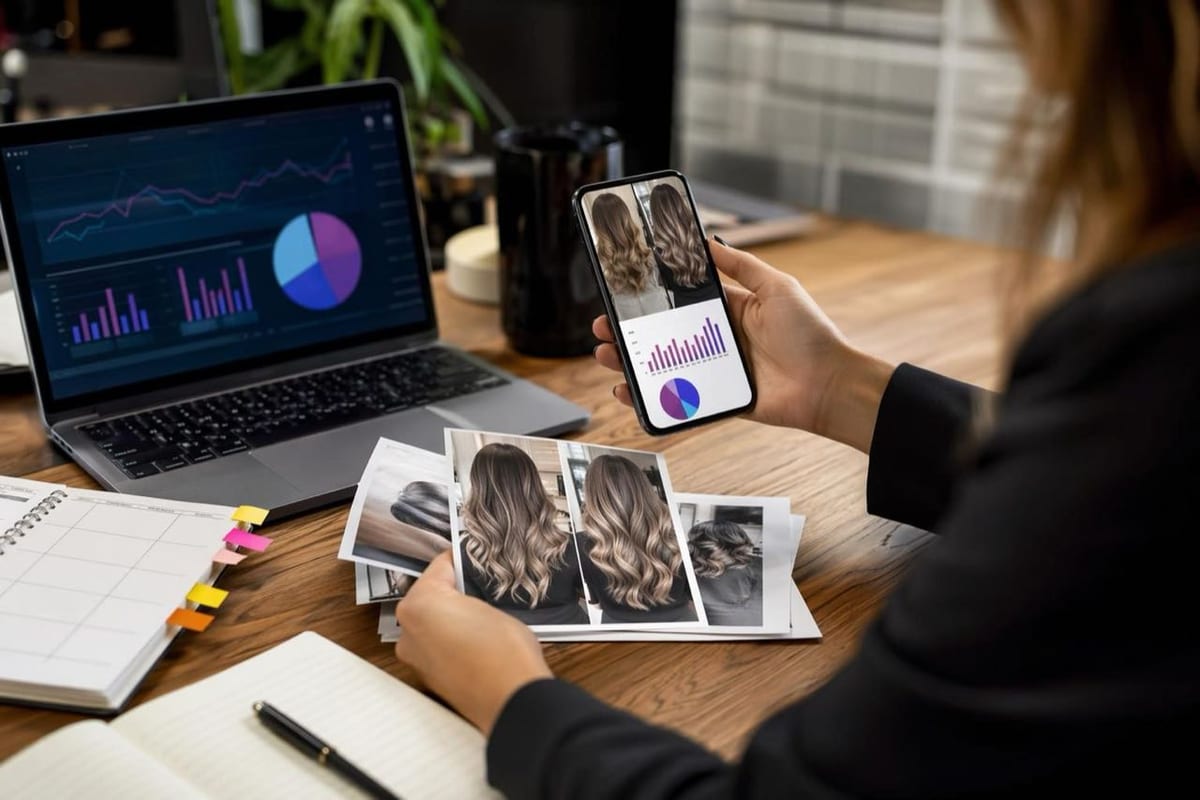
A salon doesn't need a full-time marketer to keep ads running well, a repeatable weekly routine covers most of what matters:
- Monday: check which ad angle produced the most booked appointments (not just clicks) from the prior week, and reallocate budget toward it.
- Midweek: ask one client if a quick before/after photo can be used in an ad, building the creative library one photo at a time instead of in a single big shoot.
- End of week: glance at Google reviews from the past 7 days and screenshot anything specific and glowing for the next review-based ad.
This routine keeps the ad account stocked with fresh, real creative without requiring a photographer or an agency retainer, which matters because stale creative is the single fastest way a small local budget stops performing.
FAQ
What's the best Facebook ad objective for a salon?
Use Meta's booking or conversion-focused objective tied to a tracked event on the booking page, not a generic "traffic" or "engagement" objective. The goal is appointments, not clicks, and the algorithm can only optimize toward the outcome you tell it to track.
How tight should radius targeting be for a salon?
Start at 2-3 miles for an urban location and 5-8 miles for a suburban one, then widen only if the budget can't spend within that radius. Distance is usually the single biggest predictor of whether a lead actually shows up for an appointment.
Should a salon use video or static image ads?
Both work, but before/after content performs best as a static image or a short before/after reveal video under 15 seconds. Longer video tends to lose local viewers who are scrolling quickly and just need to see the result and the booking link.
How often should salon ad creative change?
Refresh the visuals every 3-4 weeks and the seasonal angle every season. A local audience is small enough that the same ad shown repeatedly starts to feel stale and click-through rates decline as frequency climbs.
Can a salon run ads without a large photo library?
Yes. Start by asking two or three loyal clients if they'll let their before/after be used in an ad. A single strong, real before/after photo outperforms a stock library, and the library grows naturally as more clients agree over time.
Fill the Calendar, Not Just the Feed
The single most effective fix for most salon ads isn't a bigger budget, it's tightening the radius, swapping "Learn More" for a direct booking link, and using a real before/after instead of stock photography. Start with whichever of those three is currently missing from the account.
Browse 1,500+ free AI ad prompts for hook ideas that translate to local service ads, see how real local and national ads are broken down piece by piece in the teardown library, and grab the fill-in-the-blank hook formulas in 50 proven ad hook formulas. One new winning hook breakdown lands in the newsletter every week.
The AI Ad-Making Kit
$99Make hyperreal AI video and image ads for any brand, with free AI tools. No camera, no agency.
- 10 modules
- 300+ hooks
- 500+ prompts
Canva ad templates, free.
Proven D2C ad layouts. Swap in your product, export, launch.
Browse templates →Want to act on what you just read?
Browse 3,400+ free, Canva-ready ad templates sorted by industry. One click to open, five minutes to customise.
Browse Free Templates