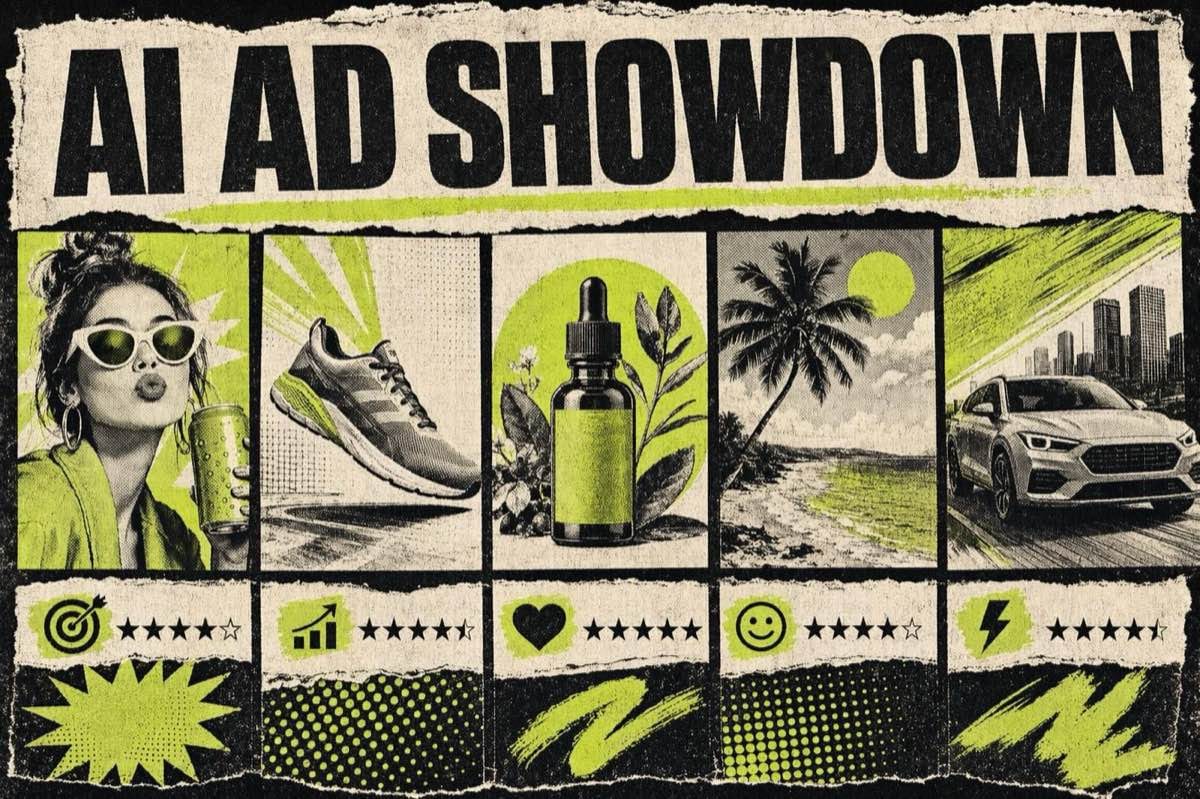
The best AI ad generators in 2026 split into three lanes: static and image tools (AdCreative.ai, QuickAds, Predis.ai), AI UGC video tools (Creatify, Arcads), and enterprise creative platforms (Pencil, Omneky, Zocket). Which one is "best" depends entirely on whether you need volume statics, avatar video, or governed production at scale.
Full disclosure before the reviews: HookAds does not make an ad generator, so nothing below is us ranking ourselves first. We publish a free library of 1,500+ AI prompts for ad creative and free ad tools, which pair with any generator on this list. That is the extent of our stake. Pricing and features below were checked against each tool's own website in July 2026; where a vendor hides pricing, we say so instead of guessing.
How We Evaluated the Best AI Ad Generators
Four questions, applied to every tool:
- What does it actually generate? "AI ads" covers everything from banner resizing to synthetic actors reading scripts. The category label hides huge differences.
- Is pricing public? Hidden pricing is not disqualifying, but you should know before you book the demo.
- Who is it really for? A solo D2C founder and a 40-person growth team should not buy the same tool.
- What is the honest catch? Every tool here has one. Credit systems, watermarks, quality ceilings, or platform-policy exposure.
One evaluation note that applies across the board: no generator fixes a weak angle. These tools multiply your creative output; they do not decide what the ad should say. That part is still strategy, which is why teams pair generators with teardowns of winning ads and proven hook structures.
Best AI Ad Generators Compared: The Quick Table
- Tool — Category — Public pricing — Best for
- AdCreative.ai — Static + creative scoring — From $39/mo, 7-day trial — Volume static testing
- Creatify — AI UGC video — Free tier; $39 to $99/mo — Avatar video ads from a URL
- Arcads — AI UGC video — Not published on site — AI-actor ads at scale
- Predis.ai — Social + ad creatives — From $19/mo — Budget social-first teams
- QuickAds — Image + video + ad library — Free start; Pro from $99/mo — Research plus generation in one
- InVideo — AI video generation — Free tier; paid plans — Long and short video beyond ads
- Canva (Magic Studio) — Design suite with AI — Free plan; paid Pro tier — Teams already in Canva
- Pencil — Enterprise AI marketing OS — Demo only — Large brands, governance needs
- Omneky — Multi-channel ad generation — Demo-led — Performance teams, many channels
- Zocket — Enterprise brand marketing OS — Demo only — Enterprise brand + paid media
- Icon — Pivoted to human UGC — $999/mo — Done-for-you human UGC
- Superads — Creative analytics (not generation) — Free to start — Analyzing what you generated
Now the honest detail.
Static and Image Ad Generators

AdCreative.ai
AdCreative.ai is the most established name in static generation. Feed it your brand kit and product images and it produces scored banner and image variations, plus text copy, competitor ad insights, and product photoshoots. Pricing on its site runs from a $39/month Starter (10 credits, 1 brand) through a $249/month Professional to a $999/month Ultimate tier, with a 7-day free trial. The catch: credits go fast if you iterate a lot, and output can look recognizably "AdCreative-shaped" unless you push custom templates. Strong for high-volume static testing where quantity of variations matters more than art direction.
Predis.ai
The budget pick. Predis.ai generates social posts, carousels, videos, and ad creatives, with scheduling and competitor analysis built in. Public pricing starts at $19/month (Core) and tops out at $212/month for Enterprise+. It is built more for social content than pure performance ads, so treat it as a content engine that also makes ads, not a dedicated ad platform. For a small team feeding both organic and paid, that dual use is the appeal.
QuickAds
QuickAds combines a 30-million-ad inspiration library with AI image and video generation, plus virtual product photography. The DIY tier is free to start with Pro plans from $99/month, and there is a $1 trial. The company advertises aggressive average-ROAS claims on its site; treat vendor-reported ROAS numbers from any tool, this one included, as marketing rather than benchmarks. The ad library plus generator combination is genuinely useful: research what is running, then generate your variation in the same tool.
Canva Magic Studio
Not a dedicated ad generator, but for many small teams it is the honest answer. Canva's Magic Studio adds AI text, image generation, and resizing on top of thousands of ad templates. There is a free plan; Pro pricing is listed on canva.com (their site blocks automated access, so check current numbers there). The catch is the opposite of AdCreative's: great general design tooling, but no performance features. No scoring, no ad-account integration, no creative analytics.
AI UGC and Video Ad Generators
This is the fastest-moving lane, and the one with the most policy nuance. These tools generate the ads people call AI UGC: synthetic actors delivering your script to camera. For context on where that format fits in a real creative strategy, see our complete guide to UGC ads.
Creatify
Creatify generates video ads from a product URL: paste a link, pick an AI avatar, get a talking-head ad with b-roll. Its published pricing is friendly for testing: a free tier with 10 monthly credits (watermarked), Starter at $39/month, Pro at $99/month. Also includes competitor ad tracking and direct publishing to Meta and other platforms. The catch is the quality ceiling: avatar delivery has improved a lot but still reads as synthetic to attentive viewers, so it fits fast hook testing better than brand-defining creative.
Arcads
Arcads is the name performance marketers drop for AI-actor ads, with over 1,000 AI actors, emotion control, and 30+ language support. Two honest flags. First, Arcads does not publish pricing on its website; plans appear after account creation, and third-party reviews describe credit-based plans in the low hundreds of dollars monthly, which we could not verify on the vendor's own site. Second, like all synthetic-actor tools, output falls under Meta's evolving disclosure rules for photorealistic AI people. Teams that swear by it use it the same way: generate many script variations cheaply, find the winning angle, then decide whether to scale the AI version or reshoot with a human.
InVideo
InVideo is a general AI video generator rather than an ads specialist, with access to frontier video models (its site lists Sora 2 and Veo 3.1 era models) plus stock, voice cloning, and editing. There is a free watermarked tier; its pricing page lists paid Plus and Max tiers, with third-party reviews in 2026 placing them around $25 and $60 monthly. Pick it when you need video capability broadly, not just ad units.
Omneky
Omneky generates ad variations across images, video, and UGC-style formats, distributes them across Meta, Google, LinkedIn, Reddit, and other channels, and layers computer-vision analytics on performance. No public pricing; it is demo-led and aimed at performance marketing teams rather than solo founders. The pitch is breadth: one brief becomes on-brand variations across every channel you run.
Enterprise Platforms
Pencil
Pencil positions itself as an AI operating system for marketing: it orchestrates multiple models (its site names OpenAI, Google, Adobe, and Runway integrations) under enterprise governance, brand safety guardrails, and SOC 2 compliance. No public pricing; sales-led. It makes sense at the scale where the problem is not "make me an ad" but "let 200 marketers generate content without breaking the brand."
Zocket
Zocket has moved upmarket into an enterprise brand-marketing OS covering brand monitoring, creative production studios, consumer research, and paid media management. Its site cites 200+ enterprise brands. No public pricing, demo-led. Evaluate it as a platform consolidation decision, not a creative tool purchase.
Two That Are Not What They Seem
Icon
Icon launched as "The AI Admaker" and became one of the most-hyped names in the category. As of mid-2026, its own website sells the opposite: "The Human Admaker," a $999/month service delivering six human-filmed UGC ads per month, with creators, scripts, shipping, and editing handled for you. It is a notable data point about the category: one of AI UGC's loudest entrants now leads with 100% human content. If you want done-for-you human UGC and the budget fits, it is effectively a productized agency now, not an AI generator.
Superads
Superads shows up on AI ad tool lists, but it is a creative analytics platform, not a generator. It analyzes your paid creative performance across accounts and surfaces which concepts, hooks, and formats drive results. There is a free starting tier. We include it because it answers the question every generator creates: you made 50 ads, now which ones deserve budget? Pair one generator from this list with an analytics layer and you have an actual creative system.
Which AI Ad Generator Should You Pick?

Match the tool to the job, not the hype:
- Solo founder, mostly statics, small budget: Predis.ai or Canva first, AdCreative.ai when volume testing starts paying for itself.
- D2C media buyer who needs video hooks fast: Creatify to start (public pricing, free tier), Arcads if you are comfortable with sales-gated pricing and want the bigger actor library.
- Team running 4+ channels: Omneky or QuickAds, depending on whether analytics or ad-library research matters more to you.
- Enterprise with governance requirements: Pencil or Zocket, and accept the demo process.
- Want humans, not avatars, done for you: Icon's current human offering, or brief UGC creators yourself using the process in our UGC ads guide.
Whatever you choose, remember what these tools are: multipliers on your inputs. A generator fed a weak brief produces weak ads faster.
FAQ
What is the best AI ad generator overall?
There is no single best, because the category spans static images, avatar video, and enterprise platforms. For public pricing and fast starts, AdCreative.ai (statics) and Creatify (AI UGC video) are the most accessible entry points. Enterprise teams with governance needs should look at Pencil or Omneky instead.
Are AI-generated ads allowed on Meta and Google?
Yes, both platforms accept AI-generated creative. Meta requires disclosure for photorealistic AI-generated people in certain contexts, and policies keep evolving, so review current ad standards before scaling synthetic-actor ads. Standard AI-generated statics and product imagery face no special restrictions beyond normal ad policies.
How much do AI ad generators cost?
Verified public pricing ranges from free tiers (Creatify, QuickAds, Canva) through $19 to $99 monthly for most self-serve plans, up to $249 to $999 monthly for high-volume tiers. Enterprise platforms like Pencil, Omneky, and Zocket do not publish pricing and sell through demos.
Can AI ad generators replace UGC creators?
Not fully. AI avatar tools are excellent for cheap, fast hook and script testing, but genuine reactions, product handling, and creator trust still favor humans. Many teams test angles with AI, then hand winning scripts to human creators. Icon's pivot from AI to human ads shows the demand runs both ways.
Do I still need a copywriter or strategist with these tools?
Yes, more than ever. Generators multiply output but do not choose the angle, the objection to attack, or the offer. Teams that win with these tools feed them researched hooks and briefs. Free resources like prompt libraries and ad teardowns cover that thinking layer without adding another subscription.
Steal the thinking layer for free
Every tool above solves production. None of them solve what to say. That layer is free: browse 1,500+ AI ad prompts built for exactly these generators, see how winning ads are constructed in our teardowns, and get one new hook breakdown each week in the newsletter. Then let whichever generator you picked do the rendering.
The AI Ad-Making Kit
$99Make hyperreal AI video and image ads for any brand, with free AI tools. No camera, no agency.
- 10 modules
- 300+ hooks
- 500+ prompts
Canva ad templates, free.
Proven D2C ad layouts. Swap in your product, export, launch.
Browse templates →Want to act on what you just read?
Browse 3,400+ free, Canva-ready ad templates sorted by industry. One click to open, five minutes to customise.
Browse Free Templates