 Chapter 10 / 10
The Creative Feedback Loop: How to Stop Starting From Scratch Every Week
Most operators sit down every Monday and try to come up with new ad ideas from nothing. Blank page, no system, hoping something clever shows up. By Friday they've shipped a handful
Most operators sit down every Monday and try to come up with new ad ideas from nothing. Blank page, no system, hoping something clever shows up. By Friday they've shipped a handful of guesses, learned almost nothing structured from them, and next Monday they start from scratch again.
Eight-figure brands don't work this way. They launch hundreds of ads a month, and none of it comes from a blank page. It comes from a loop that gets smarter every time it runs.
Scaling an ecommerce brand is simpler than it looks. It comes down to one thing nobody talks about: intent. Think of your brand like a car. The more fuel you pour in, the further it drives. The fuel is data, and the fastest way to make more of it is a feedback loop that turns every ad you run into a lesson about your buyer. This is the chapter that connects everything in this playbook into a system you can run forever.
Intent is the fuel
The reason the feedback loop matters is that every ad you launch is either data or waste, and the difference is whether you launched it with intent.
An ad launched on a hunch, with no articulated reason for why it might work, teaches you nothing when it wins or loses. You can't tell what drove the result, so you can't repeat it or avoid it. An ad launched as a specific hypothesis (this desire, this awareness stage, this hook, for this reason) teaches you something either way. If it wins, you learned the hypothesis was right. If it loses, you ruled something out. Both outcomes are fuel.
That's the whole reason to track the intent behind every ad, not just its results. The results tell you what happened. The intent tells you why, and why is what compounds.
The loop

The feedback loop has five stages, and the point is that you level up every time it repeats.
Research deep. Understand the buyer at a level your competitors don't. This is the stage that determines the quality of everything downstream.
Make high-quality hypotheses. Turn the research into specific, testable bets. Not "let's try a new hook," but "this segment is driven by a fear we haven't named yet, so an ad that names it should outperform our current angle."
Create ads based on those hypotheses. Produce creative that's designed to test the bet, using the production systems from the earlier chapters.
Learn whether you were right or wrong. Track every ad against the intent behind it. Did the hypothesis hold?
Repeat. Feed the learning back into the next round of research.
Each time the loop runs, you know more. More about the angles, the core desires, the hidden fears. Everything gets clearer, but only if you tested and tracked every single ad and the intent behind it. Skip the tracking and you run the same loop a hundred times without ever leveling up.
Good research is not reading Reddit posts
Here's the catch that determines whether the loop works: it all depends on how good your research is. And good research is not skimming a few Reddit threads.
Reddit, YouTube comments, and reviews are inputs, and the earlier chapters lean on them for good reason, but reading a handful of posts and calling it research is where most operators stop, and it's why their hypotheses are shallow. Shallow research produces shallow hypotheses, which produce ads that all sound like slight variations of the same guess. Deep research produces a real point of view about who the buyer is, what they're secretly worried about, and what they don't yet know they want, which is exactly what an unaware ad needs (Chapter 4) and exactly what AI cannot generate for you.
The depth of your buyer understanding is the ceiling on your creative. You can't out-produce bad research with more volume. You can only out-produce it with a better hypothesis, and a better hypothesis comes from doing the research everyone else skips: reading dozens of reviews instead of two, cross-referencing survey language against Reddit language against competitor 5-star reviews, and building a documented picture of the buyer that gets richer every loop.
Iterate the winning ad, not just the hook
When an ad wins, the default move is to swap the hook and relaunch. New first three seconds, same everything else. It's 2026 and people are still doing this, and it leaves most of the upside on the table.
A winning ad is a winning hypothesis about your buyer. Iterating only the hook treats the hook as the only variable that mattered, when the real win might be the desire it spoke to, the awareness stage it targeted, the mechanism it installed, or the emotional truth it named. To actually iterate a winner, you vary the parts that carry the hypothesis:
- The desire. Rewrite the same winning structure for a different desire (Chapter 1). The paint by numbers brand's 8x came from a new desire, not a new hook.
- The awareness stage. Take a winning problem-aware ad and rebuild it as an unaware ad that opens a colder buyer (Chapter 4).
- The format. Run the winning angle as a text-heavy ad, then a yapping video, then an animated explainer (Chapter 5). Same story, different machine.
- The mechanism. Keep the pain, change the explanation of why it exists and why your product is the only fix (Chapter 6).
- The hook. Yes, vary this too, but as one variable among several, not the only one.
Change one meaningful variable per iteration so you can actually learn what drove the result, the same controlled-iteration discipline that makes AI prompting converge (Chapter 8) and A/B testing beat redesigns. Swap five things at once and a win teaches you nothing, because you can't tell which change caused it.
When to change the desire, not the creative
The loop also tells you when you've hit the edge of a desire instead of the edge of your creativity.
If you've been stuck at the same revenue for six or more months, tried multiple genuine creative angles for the same desire, watched CPA climb no matter what, and your desire is sitting in a seasonal low, that's not a signal to make more creative. It's a signal that you've saturated the desire. More ads for a maxed-out desire produce more results that look exactly like the old results.
This is the single most overlooked lever in scaling, and the whole playbook points at it. Everyone wants to tweak the campaign structure or make new videos. The real unlock is usually a new desire that opens a completely different, often much bigger, segment of the market. When the feedback loop shows a desire is exhausted, you don't restart from a blank page. You pull the next desire from the list you built in Chapter 1 and run the loop again on fresh ground.
Putting the whole playbook together
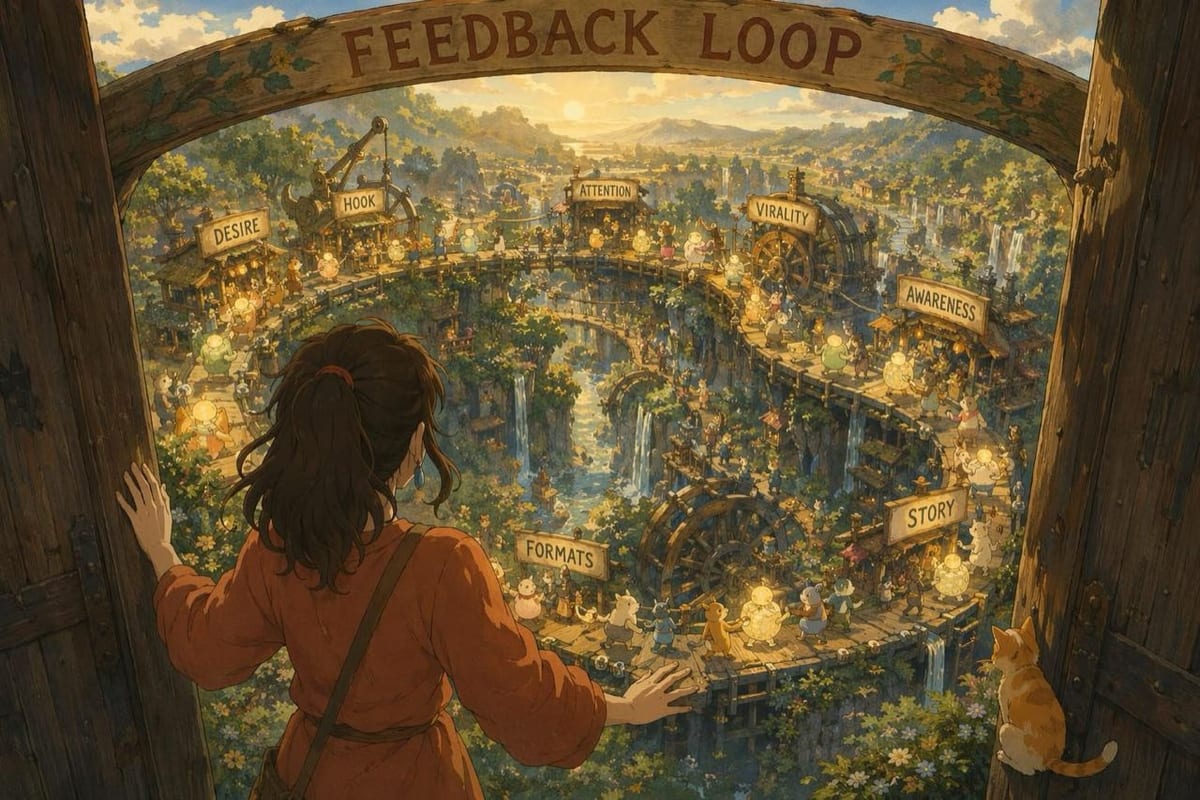
Every chapter in this playbook is one part of a single system, and the feedback loop is what runs it.
Start with desire (Chapter 1): what your product helps people become, how big that market is, how intense the want is right now, and how the season moves it. Wrap that desire in a hook (Chapter 2) engineered on the actual mechanics of attention, and understand that virality itself is a mechanism you can predict and produce (Chapter 3). Decide which awareness stage you're speaking to, and write the unaware ads that open markets nobody else can reach (Chapter 4). Tell that story across a diversity of formats with human judgment behind each one (Chapter 5), and when the traffic is cold, build the native advertorial funnel that sells a stranger on a single page (Chapter 6). Produce all of it with the AI UGC stack (Chapter 7), powered by prompts that turn a cheap generation into something that stops a scroll (Chapter 8). Distribute it through paid and organic engines at once (Chapter 9). Then run the feedback loop over the entire thing, so every ad makes the next one smarter.
The strategy decides what to say. The AI decides how much you can make. The loop decides how fast you learn. Get the desire and the hook right first, let the production engine handle the volume, and let the loop compound. That's how you stop starting from scratch every week, and start building something that gets sharper every time it runs.
The checklist
- Launch every ad as a hypothesis with a stated reason — an ad without intent teaches you nothing whether it wins or loses
- Track the intent behind every ad, not just the results — the why is what compounds
- Do the research everyone else skips — dozens of reviews cross-referenced, not two Reddit threads
- Iterate winners by the variable that carries the hypothesis — desire, awareness stage, format, or mechanism, not just the hook
- Change one meaningful variable per iteration so a win actually teaches you something
- When a desire is saturated (6+ months stuck, CPA climbing), change the desire, not the creative
- Run the loop over the whole system — desire, hook, format, funnel, production, distribution — so each cycle levels up the next
← [Back to the HookAds Playbook Index](README.md)