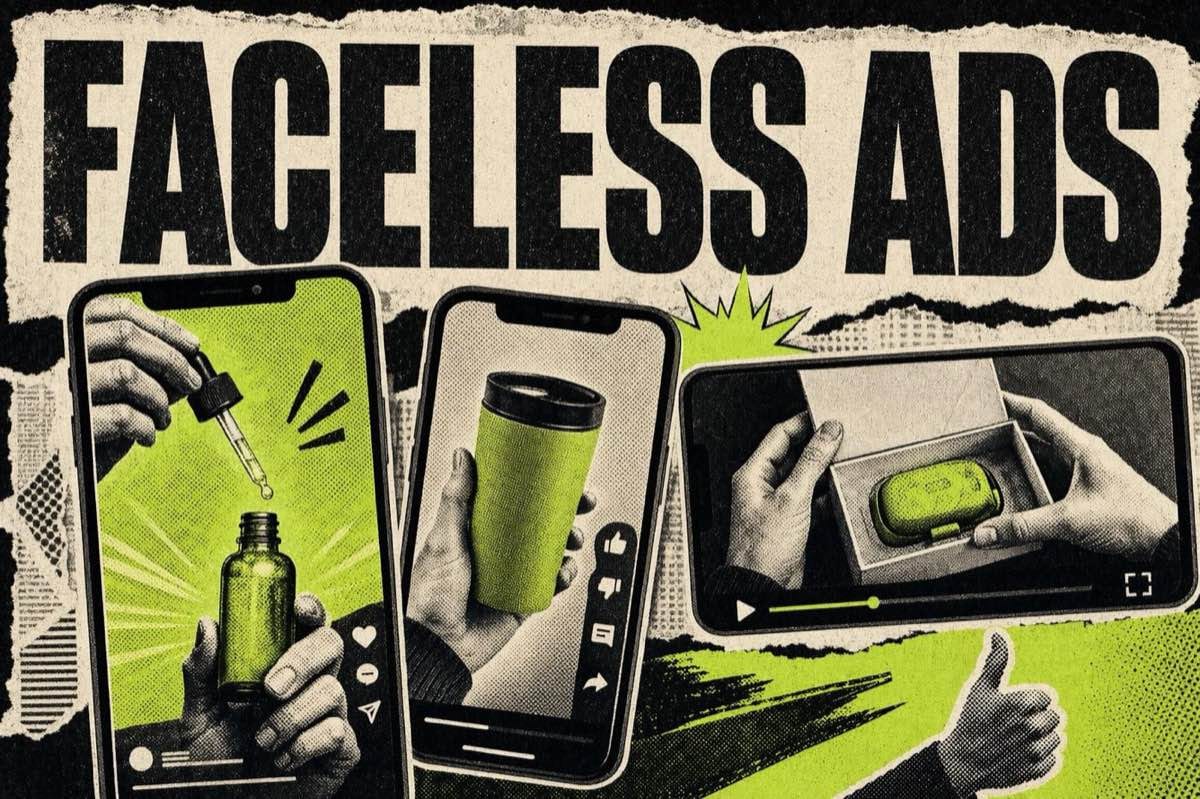
Faceless creator content, short videos built around product demos, text overlays, and voiceovers rather than a person on camera, has grown from a niche YouTube strategy into a mainstream format that is showing up in paid ad feeds across Instagram Reels and YouTube Shorts.
The format works without a human face because the product itself is the character.
What It Actually Looks Like
A faceless creator ad typically features:
- A close-up product shot or hands-in-frame demo (the product being used, opened, poured, assembled, or applied)
- A text overlay on screen narrating what is happening
- Either no audio, lo-fi background music, or a voiceover that sounds like a curious friend explaining something, not a brand announcer
- A clear before/during/after arc even in very short formats (15-30 seconds)
The "hands and product" sub-format has been particularly effective in categories where the product's sensory qualities matter: skincare textures, food preparation, cleaning products, organizing tools. You see the product working without needing to see or trust a specific person.
Why It Is Working Right Now
The economics of this format are significantly lower than traditional UGC. You do not need a creator willing to appear on camera, manage a creator relationship, or produce content that depends on a specific person's personality being appealing to your target audience. A brand or an agency can produce faceless content in-house with a phone, a ring light, and a few products.
The algorithmic environment has also shifted in this format's favor. Both Instagram Reels and YouTube Shorts have strong recommendation loops for content that earns watch time and shares, regardless of whether the creator is building a personal brand. Faceless content that shows something genuinely interesting, a fast cleaning hack, a satisfying organizational system, a product transformation, can go wide without a face behind it.
Brands that have built faceless content channels on Instagram or YouTube report that the content performs as organic reach while also providing a library of short-form assets that can be repurposed as paid ads without additional production cost. A piece of content that earns 50,000 organic views on Reels is already proven creative before you spend a rupee putting it in front of a paid audience.
For a documented look at how brands build around this organic-to-paid flywheel, the Social Media Examiner and Later's blog have covered faceless content strategies in depth.
Who Should Try This
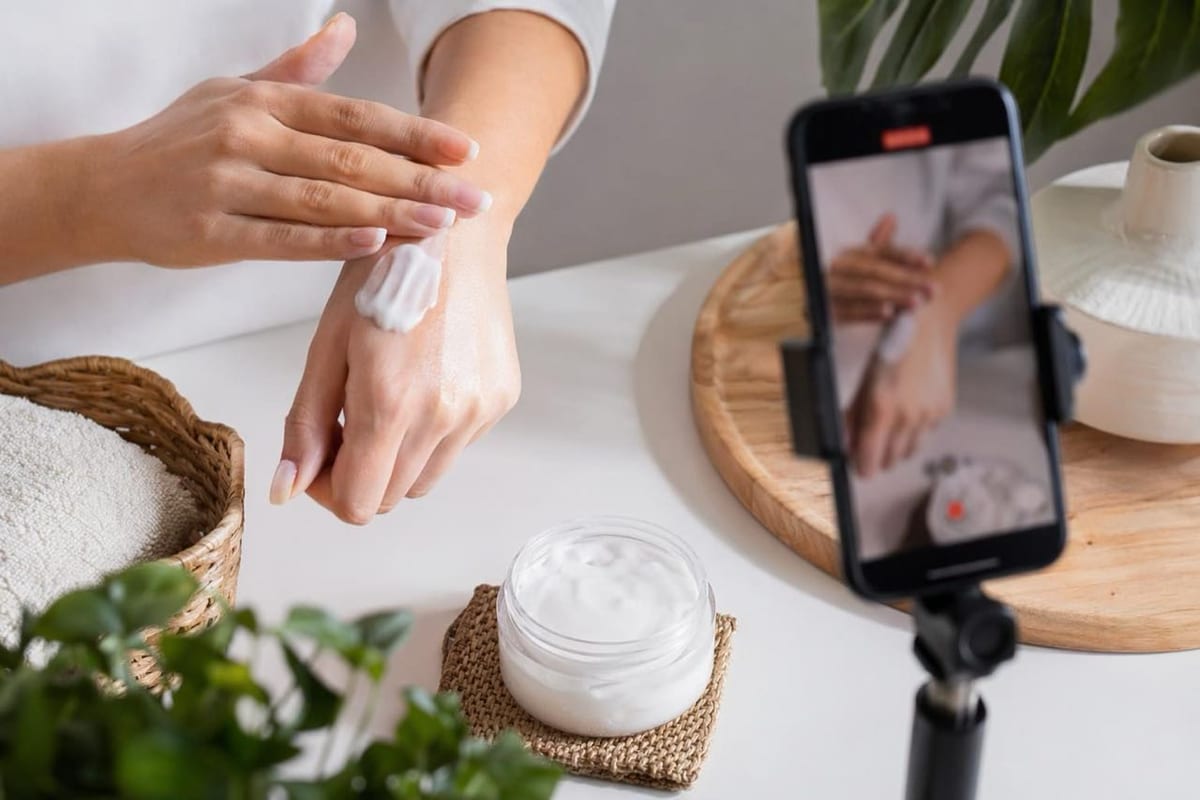
D2C brands with visually interesting products. If your product does something visible (cleans, transforms, organizes, applies), faceless demo content is a natural fit.
Brands with small creative budgets. You can produce 10 faceless video variants in a day for the cost of the products and a few hours of editing. The creative barrier is significantly lower than UGC with a human creator.
Performance marketers looking for hook variety. The "hands and product" format gives you a different visual grammar than talking-head UGC, so it can extend the life of your creative rotation when talking-head fatigue sets in.
How to Try It This Week
Pick one product with a clear visual transformation or demo moment. Set it up on a clean surface with good natural light. Film three 30-second takes from slightly different angles. Add captions with your hook line baked in. Keep the primary text simple ("This is how we ___").
Test it against your current best-performing UGC or static ad with the same targeting. Watch 3-second view rate and hook rate. If the video earns similar or better early engagement, you have a creative format worth building a library around.
What to Watch Out For
Voiceover quality matters more than you expect. A robotic AI voiceover on an otherwise good demo video is a notable drop in quality. Invest in a decent microphone or a human voiceover before scaling voiceover-led faceless content.
Product category determines ceiling. Faceless content builds trust through showing the product working, not through a person vouching for it. For high-consideration purchases where trust in a specific person's experience is a major conversion driver (some health products, high-ticket items), talking-head UGC with a real person's testimony will often outperform faceless demos at the bottom of the funnel.
Do not confuse "no face" with "no personality." The most effective faceless content still has a distinct point of view, a pacing style, and a voice. Generic demo videos with no hook and no story will not perform better than a bad UGC video just because they are faceless.
The AI Ad-Making Kit
$99Make hyperreal AI video and image ads for any brand, with free AI tools. No camera, no agency.
- 10 modules
- 300+ hooks
- 500+ prompts
Canva ad templates, free.
Proven D2C ad layouts. Swap in your product, export, launch.
Browse templates →Want to act on what you just read?
Browse 3,400+ free, Canva-ready ad templates sorted by industry. One click to open, five minutes to customise.
Browse Free Templates