"Hello, ladies. Look at your man. Now back to me. Now back at your man. Now back to me."
In six seconds, Old Spice broke a fundamental advertising rule: they sold a men's product by talking to women. The result was one of the most-studied ad campaigns of the last 20 years.
The Ad
Wieden+Kennedy created "The Man Your Man Could Smell Like" for Old Spice in 2010. It was directed by Tom Kuntz and starred former NFL player Isaiah Mustafa. The spot ran 32 seconds, filmed in a single continuous take with no edits. According to Wieden+Kennedy, it was shot on a real boat, in a real bathroom, and on a real horse : back-to-back on a single studio day.
The campaign won the Grand Prix at Cannes Lions 2010. It has since exceeded 60 million views on YouTube (Old Spice YouTube channel). In the six months after the campaign launched, Old Spice body wash sales increased by 125%, according to Nielsen data cited by the Effie Awards.
The Insight: Who Actually Buys This?
The Old Spice team and W+K did something most brands skip: they asked who actually makes the purchase decision.
Studies have consistently shown that women make or heavily influence the majority of household purchasing decisions, including personal care products. The body wash on a bathroom shelf is often chosen by a woman, for a man, or at least with a man's preferences filtered through her judgment.
So W+K wrote the ad to the actual buyer, not the user. "Look at your man. Now back to me" is not speaking to men about themselves. It's speaking to women about their men. The humor comes from the impossible promises Isaiah Mustafa makes while standing in a bathroom that magically transforms into a boat, then a beach, then a horse.
This buyer-vs-user distinction is underused in performance advertising. Most brands default to the person who will eventually use the product. When the buyer and user are different people, and especially when the buyer is a woman purchasing for a man, talking to the buyer can be the more direct path.
The Hook Mechanism: Absurd Contrast at Speed
The first six seconds work through contrast. Mustafa opens in a bathroom, speaking directly to the viewer with calm authority. Then the location changes. Then again. Each cut is invisible because the camera never breaks; Mustafa walks, reaches, turns, and the set shifts around him.
The contrast being dramatized is between what your man is and what he could be. The hook "Look at your man. Now back to me" creates an implicit comparison that is flattering to the product and slightly unflattering to the man : but it's funny enough and fast enough that it reads as playful, not insulting.
This is the Old Spice mechanic in one sentence: aspirational contrast delivered so fast and absurdly that the viewer laughs instead of deflecting.
Direct response ads use the same logic with harder language: "Before / After," "Stop doing X / Start doing Y," "The problem / The fix." The Old Spice version wraps those same beats in absurdist comedy so the brand looks charming rather than pushy.
The Production Choice That Made It Work
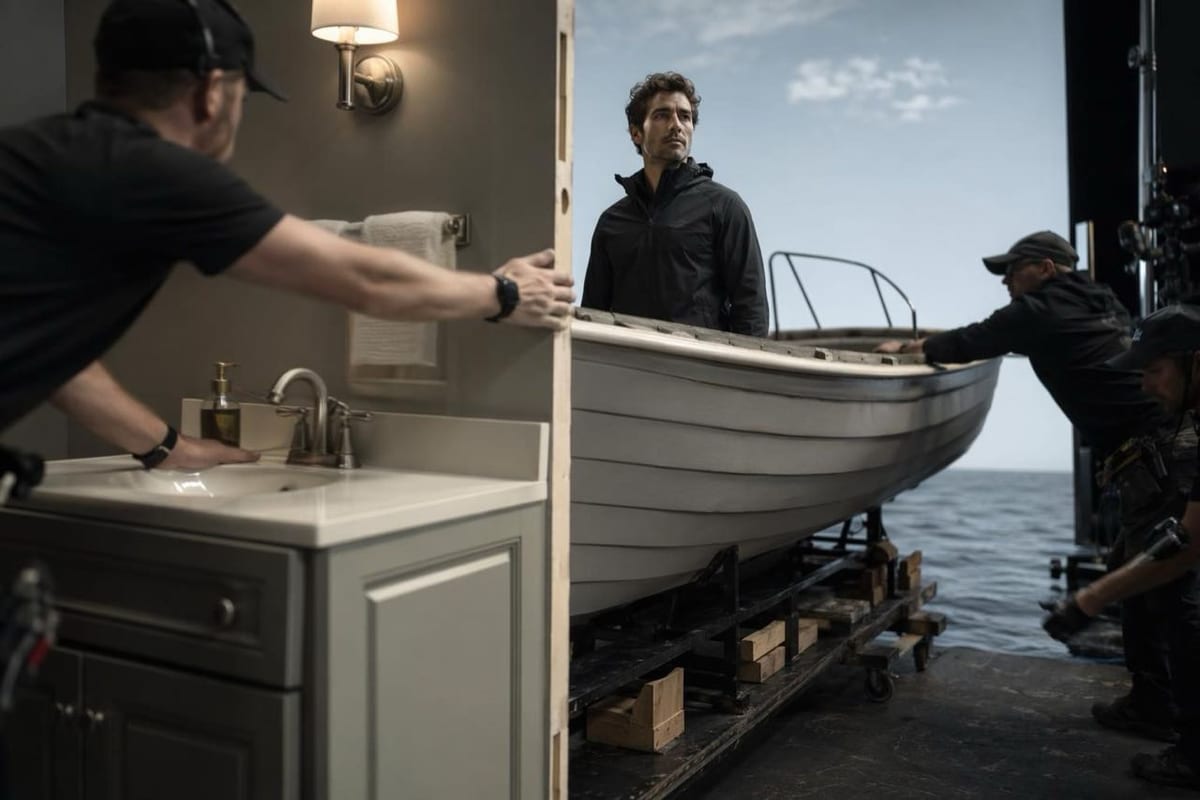
The single-take format was not a budget constraint. It was a creative decision that made the ad more impressive to watch. When the bathroom transforms into a boat and the boat becomes a horse, and you realize it happened in real time without cuts, you rewatch it to figure out how.
That rewatch behavior is what built the YouTube view count and the cultural spread. The ad was engineered to be re-watched and shared, which was relatively new thinking for a TV commercial in 2010.
For modern Reels and Shorts, the lesson is that a visible production skill : not polish, but a trick or a feat : gives the viewer a reason to watch again and send to someone. That second watch and that share are the amplification mechanism.
How to Steal This Structure
The Old Spice approach is harder to copy directly because it requires a real budget for the single-take illusion. But the underlying structure can be adapted.
Step 1 : Identify the buyer. If the person who sees your ad and the person who benefits from the product are different people, write to the buyer. "Ladies, does your man still use the same grocery-store soap he's used since college?" is a different ad than "Men, upgrade your shower routine."
Step 2 : Lead with the implicit comparison. "Now back to me" is a comparison prompt. You're asking the viewer to stack a current reality against an alternative. This works for beauty, fitness, food, home goods : anything where the gap between current state and improved state is visible.
Step 3 : Resolve absurdly, not literally. The punchline : "I'm on a horse" : is not a product feature. It's a signal that the brand doesn't take itself too seriously. That self-awareness is the brand's actual differentiator in a category (male grooming) that had been running serious athlete ads for decades.
Frequently Asked Questions
Why did Old Spice address the ad to women instead of men?
Research showed that women are a major purchase driver for household personal care products, including men's body wash. Writing to the actual buyer rather than the end user was a deliberate W+K strategy. Details on the campaign thinking are covered in Wieden+Kennedy's work archive.
How much did Old Spice sales increase after this campaign?
Nielsen data, cited by the Effie Awards, showed a 125% increase in Old Spice body wash sales in the six months following the campaign launch. The broader brand turnaround is documented in Old Spice's Effie case study (NA 2011, E-3879-421).
Can a performance marketer apply this absurdist style on Meta?
Yes, but with one adjustment: Meta's cold-traffic feed rewards a very fast hook (under two seconds), so the "look at your man" comparison prompt needs to arrive in the first frame rather than after an establishing shot. The rest of the structure : implicit comparison, absurd escalation, confident CTA : translates directly to a 15-30 second Reel.
What is "buyer vs. user" targeting and when should I use it?
Buyer-vs-user targeting means writing your creative to the person who makes or heavily influences the purchase, rather than the person who will ultimately use the product. It's most effective in categories like children's products (parents buy, kids use), gifts, and personal care (one partner often buys for the other). If your analytics show a mismatch between your creative's target demographic and your actual buyer demographic, this is worth testing.
See more campaign breakdowns in the teardowns library, or generate hook variants for your own creative with the free AI hook generator.
The AI Ad-Making Kit
$99Make hyperreal AI video and image ads for any brand, with free AI tools. No camera, no agency.
- 10 modules
- 300+ hooks
- 500+ prompts
Canva ad templates, free.
Proven D2C ad layouts. Swap in your product, export, launch.
Browse templates →Want to act on what you just read?
Browse 3,400+ free, Canva-ready ad templates sorted by industry. One click to open, five minutes to customise.
Browse Free Templates