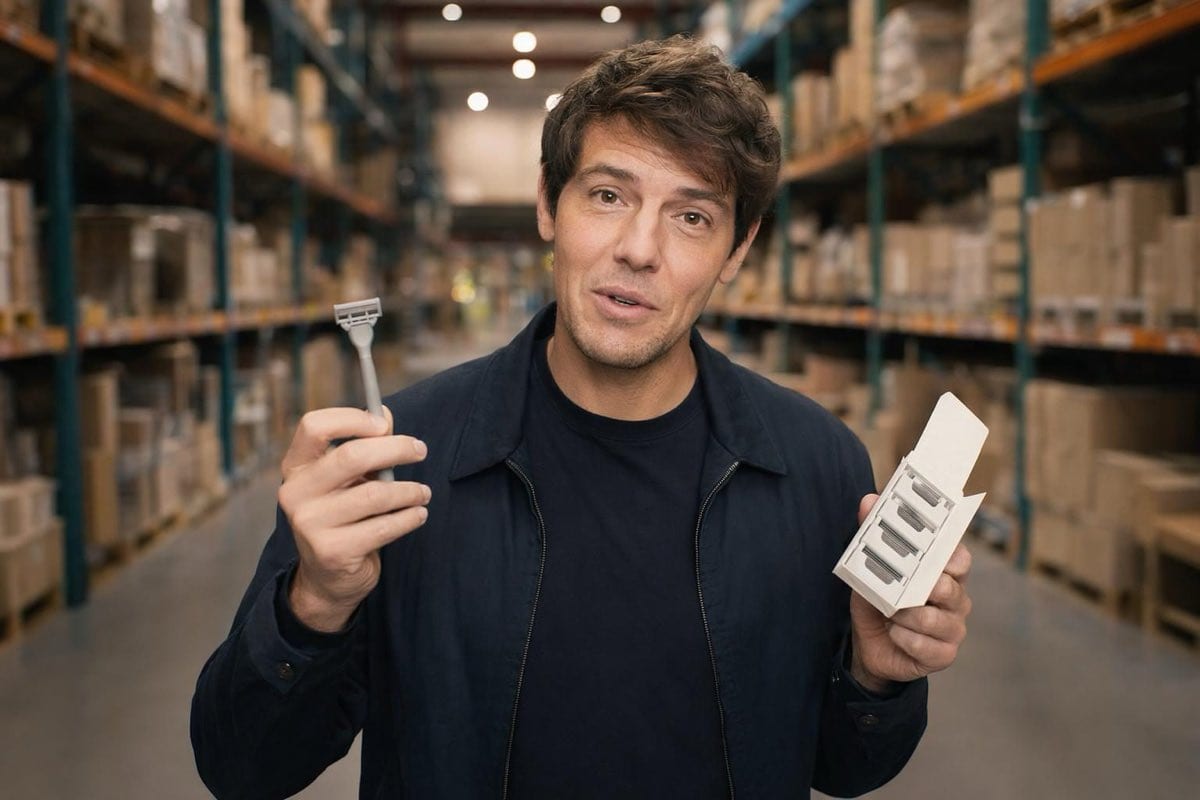
Michael Dubin walks into frame, looks straight at the camera, and says: "Hi, I'm Mike. And this is DollarShaveClub.com. What is our club? For a dollar a month, we send high-quality razors right to your door."
That's it. That's the hook. No celebrity. No fancy set. No AI-generated visuals. Just a guy in a warehouse promising a dollar a month for something every man already buys.
What followed made marketing history.
The Ad
Dollar Shave Club uploaded their launch video to YouTube on March 6, 2012. It ran for 1 minute 33 seconds. Director Alec Brownstein shot it in a single day at the Dollar Shave Club warehouse in Venice, California for roughly $4,500 (via Fast Company).
Within 48 hours of going live, the company had received over 12,000 orders and their website crashed multiple times from traffic. By the end of that first week, they had 25,000 subscribers.
The Hook: Clarity First, Humor Second
The hook works because it answers the only question a cold viewer has: "What is this?" Most DTC ads in 2012 buried the offer under brand storytelling. Dollar Shave Club put it in sentence one.
"For a dollar a month, we send high-quality razors right to your door."
That's the offer. Right there. Inside the first eight seconds. The comedy comes after, not instead of, the value proposition. This sequence matters. If you lead with the joke and bury the offer, you get views and no conversions. If you lead with clarity and layer humor on top, you get both.
The specific number ("a dollar a month") does the heavy lifting. It's not "affordable." It's not "low-cost." It's one dollar. That number is so low it sounds like a trick, which creates a question in the viewer's mind: how is that possible? That open loop is what keeps people watching.
The Mechanism: Pain + Ridicule + Resolution
The script moves through three beats in rapid succession.
Beat 1 : Name the enemy. "Do you think your razor needs a vibrating handle, a flashlight, a back scratcher, and ten blades?" The enemy is Gillette's feature bloat. Dubin doesn't name Gillette directly, but every man watching knows exactly what he's talking about. Naming an enemy your audience already resents is faster than building a villain from scratch.
Beat 2 : Make the incumbent look absurd. The line "Are the blades any good? No, our blades are f***ing great" (which became the most-quoted moment from the ad) worked because it broke every rule of polished brand communication. At that time, razor brands ran ads with athletes and slow-motion water. Dollar Shave Club ran an ad with a man in a warehouse, a giant bear mascot, and a toddler shaving a man's head. The contrast made the incumbents look ridiculous by comparison.
Beat 3 : Make joining feel obvious. "Stop paying for shave tech you don't need" resolves the tension the script created. You don't have to be persuaded. You're just stopping something stupid.
Why It Converted
Three structural choices drove the conversion rate.
No feature list. The ad sells convenience and price, not blade count or metallurgy. This is the right call when you're selling a commodity product against entrenched brands with more features. When you can't win on specs, win on the experience of buying.
Founder-as-character. Mike Dubin was the brand. He was likable, specific, and slightly unhinged. Viewers trusted him in the way you trust a friend's recommendation over a polished ad. This is what people mean when they say UGC outperforms studio work: it's the character, not the production value.
One ask at the end. The CTA is a URL and nothing else: "DollarShaveClub.com." No phone number, no email sign-up, no limited-time offer. One action. This kept friction at zero on a channel where people don't convert in multiple steps.
How to Steal This Structure
You do not need a warehouse or a $4,500 budget. You need the sequence.
- Open with the offer in plain language (price + what they get + how often). Ten seconds max.
- Name an enemy your audience already resents. Make it specific and make it sound absurd.
- Use at least one moment of earned absurdity: a line, a visual, a prop. Not a random joke : something that dramatizes the enemy's absurdity.
- Close with a single action and nothing else.
The formula works best when your product solves a recurring purchase problem in a category people resent paying for. Razors, printer ink, supplements, cleaning supplies, coffee pods : any category where the incumbent pricing feels insulting is ripe for this treatment.
Frequently Asked Questions
What made the Dollar Shave Club launch video go viral?
The combination of a clear, specific offer (one dollar a month), a relatable enemy (overpriced razor tech), and humor that punched up rather than down. It also launched at a time when DTC brands didn't yet run comedic video ads, so the contrast with polished Gillette and Schick creative was extreme. See AdWeek's coverage for the early social spread data.
How much did the Dollar Shave Club launch video cost to produce?
Approximately $4,500 according to founder Michael Dubin, as reported by Fast Company. The budget covered one day of shooting at their Venice warehouse.
Can a small brand replicate this style today?
Yes, but the bar has moved. In 2012 the format was new. Today, founder-led deadpan video is a common DTC playbook. The underlying principles still apply: lead with the offer, name a specific enemy, use one moment of earned absurdity, close with one CTA. What no longer works is simply copying the tone without a genuinely different offer or category insight underneath it.
Does humor always work in direct response video ads?
Humor works when it dramatizes a real customer frustration rather than being random entertainment. The Dollar Shave Club video is funny because the frustration it's poking at (paying $20 for a razor cartridge pack) is genuinely felt. Random humor without a grounded tension rarely converts cold traffic.
Want to see more ads broken down this way? Browse the full teardown library, or use the free AI hook generator to draft opening lines for your own video scripts.
The AI Ad-Making Kit
$99Make hyperreal AI video and image ads for any brand, with free AI tools. No camera, no agency.
- 10 modules
- 300+ hooks
- 500+ prompts
Canva ad templates, free.
Proven D2C ad layouts. Swap in your product, export, launch.
Browse templates →Want to act on what you just read?
Browse 3,400+ free, Canva-ready ad templates sorted by industry. One click to open, five minutes to customise.
Browse Free Templates