At the end of 2010, Airbnb had roughly 700,000 listed nights in 89 countries. Two years later, it had grown to 10 million nights in 192 countries. A significant part of that growth came from a referral program that its growth team, led by Gustaf Alströmer, documented publicly.
This case study uses only data Airbnb has disclosed in public talks, blog posts, and published interviews.
The Program
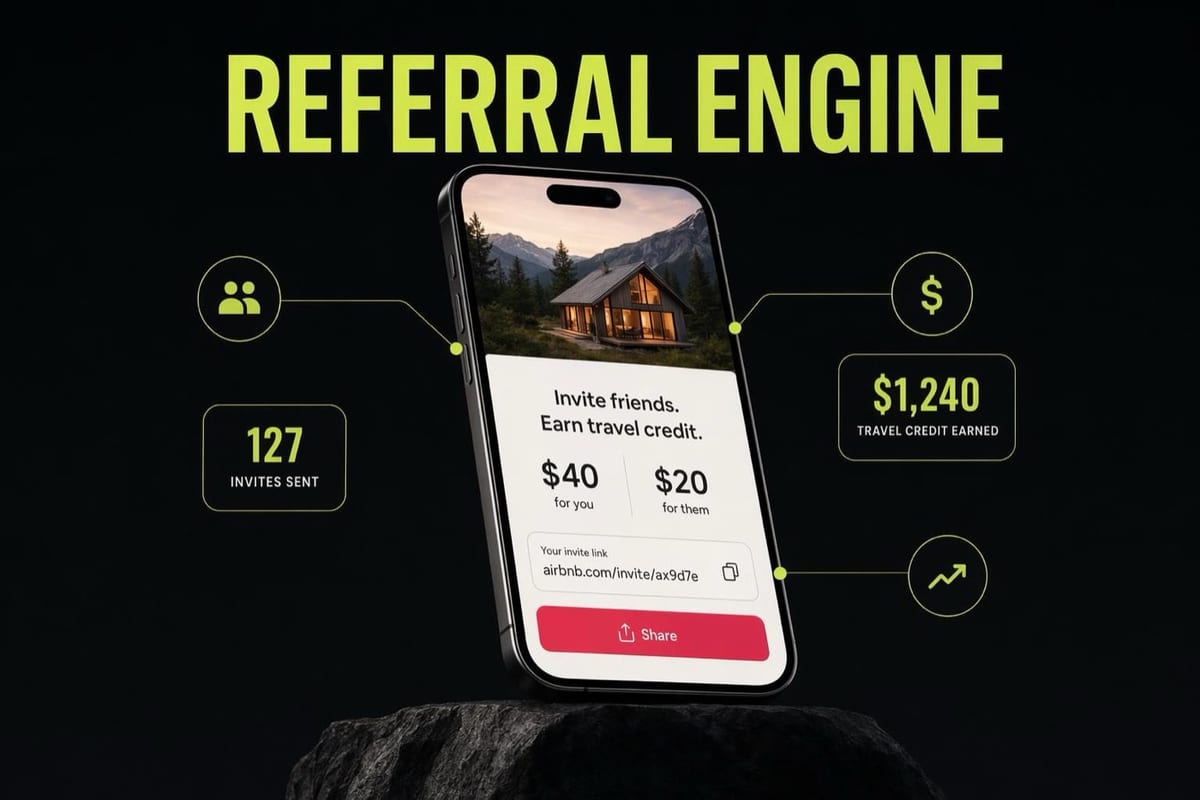
Airbnb launched a formalized referral program in late 2011. The mechanics were straightforward: existing users got a credit when they referred a new user who completed a booking. The referred user got a credit on their first booking. Two-sided incentives are common; what distinguished Airbnb's execution was the optimization work they put into it.
Gustaf Alströmer, who led growth at Airbnb from 2011 to 2017, described the program in a public Y Combinator talk (available via YC's YouTube channel) and in a 2018 First Round Capital interview (First Round Review). He noted that during the period when referrals were tuned, they drove bookings at rates that exceeded other acquisition channels.
A figure frequently cited in growth marketing writing is that Airbnb's referral program generated a 900% increase in signups year-over-year at one point during 2012. This figure derives from Alströmer's own public presentations and has been cited in multiple sources including Andrew Chen's blog post on viral growth based on conversations with the Airbnb growth team. (Note: this represents a peak rate during an optimization period, not a sustained long-term baseline.)
What Made the Referral Program Work
Most referral programs underperform because they are bolted on as an afterthought. Airbnb's growth team treated it as a core product, running systematic tests across every component.
The invite copy mattered more than the incentive size. Alströmer discussed in his YC talk that they A/B tested hundreds of variations of referral invitation copy and found that the framing of the message to the recipient was more predictive of conversion than the credit amount itself. Personal language ("Your friend [Name] thinks you'd love this") consistently outperformed generic marketing copy.
They optimized for two-sided trust. The challenge with a two-sided marketplace is that both the inviter and the invitee need to feel the incentive is fair and the product is trustworthy. Airbnb designed the credit structure so that the inviter's reward arrived only after the invitee actually completed a booking : which meant inviters had an incentive to genuinely recommend Airbnb rather than spray invites at every email address they had.
Mobile and email were tuned separately. The growth team built separate invite flows for mobile contacts and email contacts, because the behavioral context and expected conversion window differed. A text invite from a friend converted faster than an email, but email reached a broader audience.
The Craigslist Integration (The Growth Move That Came Before)
The referral program was not Airbnb's first growth engineering project. An earlier, widely-documented effort was their informal integration with Craigslist.
Airbnb hosts who listed on Airbnb were given the option to cross-post their listing to Craigslist (a much larger platform at the time) with a single click. This was not an official Craigslist partnership : the team engineered it by reverse-engineering Craigslist's posting structure. The result was that Airbnb hosts effectively advertised Airbnb on Craigslist for free.
This project is documented in detail by Andrew Chen in the post How Airbnb Grew From 0 to 500M Nights Booked, drawing on public statements by Airbnb co-founders.
The Craigslist integration and the referral program share a common logic: find where your target audience already is, and make it trivially easy for your existing users to bring them to you.
The Product Growth Loop This Created

The referral program worked because Airbnb's product already had high satisfaction rates among early users. A referral program amplifies existing happiness; it does not create it. Alströmer made this point explicitly in his YC talk: the best referral programs are discovery mechanisms for a product that already has word-of-mouth energy.
The growth loop looked like this:
- User books with Airbnb, has a good experience
- User shares a referral link with a friend (motivated by the credit and genuine enthusiasm)
- Friend books, gets their credit, has a good experience
- Friend becomes a new referrer
Each booking fed the next invite cycle. The loop was self-reinforcing as long as the product quality stayed high.
What Advertisers and Brand Builders Can Take From This
Referral programs only work if satisfaction is high first. Before investing in referral mechanics, measure your Net Promoter Score or your repurchase rate. If those numbers are low, fix the product, not the referral program.
Incentive size is less important than invite copy. Most brands optimize for the incentive amount. Airbnb's data, as Alströmer described it publicly, suggests that copy and timing matter more. Test your invitation message and sending timing before adjusting the credit size.
Two-sided incentives outperform one-sided ones. Giving the receiver a meaningful incentive (not just the sender) is table stakes for referral programs in competitive markets. Both parties need to feel they're getting something.
The channel your users are already in matters. Airbnb didn't invent a new channel for referrals. They built the invite mechanism into the natural post-booking flow, at the moment when user satisfaction was highest.
Frequently Asked Questions
Where can I find the original source for Airbnb's referral growth numbers?
Gustaf Alströmer's public YC talk is the primary source. It is available on Y Combinator's YouTube channel. The 900% signup growth figure has been cited in growth marketing writing based on statements from that talk and interviews with the Airbnb growth team, including in Andrew Chen's blog.
Did Airbnb's referral program have any problems?
Yes. Early versions had fraud issues : users creating fake accounts to collect both sides of the referral incentive. Airbnb's growth team built fraud detection into the program over time, including the delayed-release mechanic (credit posts only after a successful booking, not after signup). This is standard practice in mature referral programs.
Can a small e-commerce brand run a referral program like this?
The mechanics are accessible. Tools like ReferralCandy, Friendbuy, and Yotpo Referrals implement the double-sided incentive structure without custom engineering. The harder part is having a high enough satisfaction baseline. If your repurchase rate is below 20%, fix your post-purchase experience before investing in referral mechanics.
How does a referral program fit with paid advertising?
They complement each other. Paid acquisition brings users in at a cost; referrals bring in users at a much lower marginal cost from within your existing customer base. Most brands run them in parallel, using paid for top-of-funnel and referral for word-of-mouth amplification from satisfied customers.
See more real campaign breakdowns in the case studies library. To generate ad creative that drives the kind of satisfaction that feeds referral loops, browse 1,500+ AI ad prompts.

The AI Ad-Making Kit
$99Make hyperreal AI video and image ads for any brand, with free AI tools. No camera, no agency.
- 10 modules
- 300+ hooks
- 500+ prompts
Canva ad templates, free.
Proven D2C ad layouts. Swap in your product, export, launch.
Browse templates →Want to act on what you just read?
Browse 3,400+ free, Canva-ready ad templates sorted by industry. One click to open, five minutes to customise.
Browse Free Templates